- Chinese
- French
- German
- Portuguese
- Spanish
- Russian
- Japanese
- Korean
- Arabic
- Irish
- Greek
- Turkish
- Italian
- Danish
- Romanian
- Indonesian
- Czech
- Afrikaans
- Swedish
- Polish
- Basque
- Catalan
- Esperanto
- Hindi
- Lao
- Albanian
- Amharic
- Armenian
- Azerbaijani
- Belarusian
- Bengali
- Bosnian
- Bulgarian
- Cebuano
- Chichewa
- Corsican
- Croatian
- Dutch
- Estonian
- Filipino
- Finnish
- Frisian
- Galician
- Georgian
- Gujarati
- Haitian
- Hausa
- Hawaiian
- Hebrew
- Hmong
- Hungarian
- Icelandic
- Igbo
- Javanese
- Kannada
- Kazakh
- Khmer
- Kurdish
- Kyrgyz
- Latin
- Latvian
- Lithuanian
- Luxembou..
- Macedonian
- Malagasy
- Malay
- Malayalam
- Maltese
- Maori
- Marathi
- Mongolian
- Burmese
- Nepali
- Norwegian
- Pashto
- Persian
- Punjabi
- Serbian
- Sesotho
- Sinhala
- Slovak
- Slovenian
- Somali
- Samoan
- Scots Gaelic
- Shona
- Sindhi
- Sundanese
- Swahili
- Tajik
- Tamil
- Telugu
- Thai
- Ukrainian
- Urdu
- Uzbek
- Vietnamese
- Welsh
- Xhosa
- Yiddish
- Yoruba
- Zulu
- Kinyarwanda
- Tatar
- Oriya
- Turkmen
- Uyghur


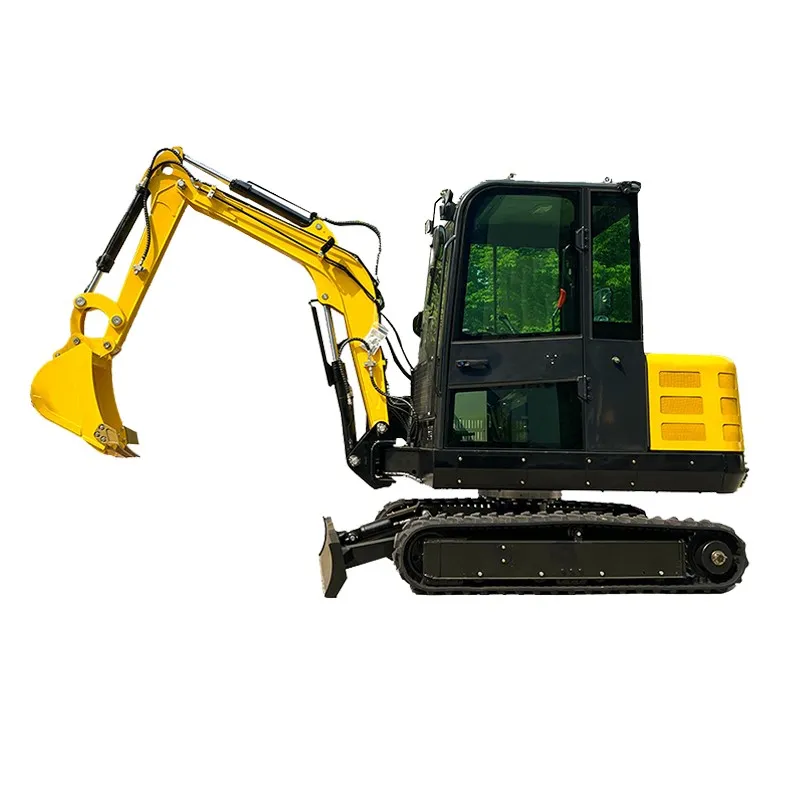
5 ton mini excavator
When most people hear '5 ton mini excavator', they think it's just a smaller, simpler machine. That's the first mistake. The 5-ton class is this critical sweet spot – big enough to handle serious work, yet compact enough for tight access. But the real story isn't in the weight; it's in how that weight is distributed, the hydraulic system's responsiveness, and the thousand little design choices that separate a reliable workhorse from a yard ornament.
The Weight Class Conundrum
So, why 5 tons specifically? It's the gateway. You're moving out of the pure landscaping realm into light demolition, utility work, and foundation digging. It's the smallest machine that can realistically handle a breaker effectively all day without shaking itself apart, provided it has the right hydraulic flow and pressure. I've seen too many guys buy based on price and a glossy spec for bucket force, only to find the auxiliary circuit can't sustain a 68mm breaker at adequate pressure. The machine just bogs down, overheats, and you're stuck.
This is where brands start to diverge. Some build to a price point for the rental market, expecting shorter service intervals and more forgiving operators. Others, often the ones with deeper engineering roots, build for ownership and longevity. The difference shows up in places you don't see on a brochure: the grade of steel in the boom pins, the routing of hydraulic hoses away from heat and abrasion points, the accessibility of daily checkpoints. A company like Shandong Pioneer Engineering Machinery Co., Ltd has been navigating this space for two decades, which means they've seen what fails and what lasts. Their recent relocation and expansion in 2023 isn't just about more space; it's usually a sign of process refinement and investment in better fabrication tech.
I remember a job site where we had two different 5-tonners side-by-side, one a well-known Japanese brand, the other a Chinese model from a maker similar to Pioneer. The Japanese machine was smoother, no question. But the other one had more raw digging force and a wider, more stable stance. For trenching in stable soil, it was actually faster. The trade-off was in the finesse of the controls. It's never a black-and-white comparison.
Hydraulics: The Heart of the Matter
If the engine is the lungs, the hydraulics are the heart and nervous system. This is where you get that 'feel'. A good system isn't just about power; it's about metering. Can you feather the controls to pick up a delicate pipe or grade a slope smoothly? Or is it all-or-nothing, jerky movement? Load-sensing systems are pretty much standard now in this class, but the implementation varies wildly.
The worst experience I had was with a machine that had great specs on paper—high flow, high pressure. But the valve block was poorly designed, creating massive heat buildup after a few hours of continuous use. The efficiency just dropped off a cliff. We had to add an aftermarket cooler, which was a hassle. When you look at a manufacturer's specs now, I always dig for the continuous duty cycle ratings and the cooling capacity. A company with a long export history to places like Germany, Australia, and North America, as mentioned in Shandong Pioneer's background, has to meet higher expectations for continuous operation in varied climates. Their machines are tested against those demands, which is a good proxy for robustness.
Another practical tip: always check the auxiliary hydraulic line configuration. Does it have a standard, quick-connect fitting? Is it a one-way or two-way circuit? For a 5 ton mini excavator that will see attachments like augers, tilt rotators, or compactors, a two-way circuit with proportional control (often called a hammer circuit) is non-negotiable. It's a cost adder, but it future-proofs the machine.
The Undercarriage & Stability Game
This is the most neglected part by first-time buyers. Everyone looks at the digging depth and reach. I look at the track gauge and the ground clearance. A 5-ton machine needs to be stable when swung with a full bucket at full reach. A wider track gauge makes a world of difference, especially on uneven ground. But there's a trade-off with transport width. Some models offer adjustable gauge widths, which is a brilliant feature if you move the machine between sites with different trailer restrictions.
Then there's the choice between rubber and steel tracks. For 90% of municipal or general construction work, rubber is the way to go. It protects surfaces, is quieter, and is fine for most soils. But if you're in rocky terrain or doing demolition, steel is the only choice. The key is the number of rollers and the track tensioning system. A simple grease gun tensioner is okay, but an automatic or manual greaseless system saves so much time and grief. I've spent too many muddy mornings under a machine adjusting tracks.
Stability isn't just static. It's dynamic. How does the machine handle a side slope? The center of gravity is crucial. Some designs, by packing the counterweight and components lower, feel much more planted. This is a subtle design art that comes from iteration and field feedback—exactly the kind of knowledge a company develops over 20 years of production and global export.
Operator Station & Daily Grind
You spend 8-10 hours in that seat. It can't be an afterthought. Ergonomics directly impact productivity and safety. The layout of the joysticks, the visibility to the bucket teeth and the right-side track, the placement of the monitor—it all matters. Newer models from serious manufacturers are moving towards customizable control patterns (ISO/SAE) and even adjustable armrests with integrated controls.
But here's a real-world headache: climate control. A basic canopy is cheap, but a pressurized cab with a proper air conditioner and heater is a productivity multiplier. In summer heat, an operator in a cool cab will outwork one in a baking canopy by hours. It also keeps the dust out. When I see a manufacturer's standard offering includes a well-sealed, pressurized cab, it tells me they're thinking about the whole work cycle, not just the machine's raw output. Checking the Shandong Pioneer website (https://www.sdpioneer.com), you can see this focus on operator environment in their cab designs, which aligns with expectations in their key export markets like the US and Canada.
Serviceability is the other half of the daily grind. Can you check the engine oil, coolant, and hydraulic fluid easily? Is the fuel filter in a spot where you can change it without spilling diesel everywhere? Are there grease points centralized, or do you have to crawl around? A design that makes daily maintenance easy is a design that ensures it actually gets done.
The Long-Term Value Proposition
Finally, it comes down to total cost of ownership. The initial price tag is just the entry fee. Parts availability, dealer support, and general durability dictate the real cost. For a 5 ton mini excavator that's likely to be a key asset for a small business, downtime is a killer.
This is where a manufacturer's global footprint and longevity matter. A company that has been exporting successfully for years, like the profile of Shandong Pioneer which notes its products are in numerous countries, typically has a more established parts and service network. They've had to standardize components and build machines that are easier to fix in the field. Their 20-year history suggests they've worked out a lot of the early-life reliability kinks that plague newer entrants.
In the end, choosing the right 5-tonner is about matching the machine's deepest capabilities—not its paper specs—to your most demanding tasks. It's about expecting finesse as well as power, and valuing the design details that keep it running smoothly for the long haul. The best machine feels like an extension of the operator, not a fight against the controls. And that feeling is the sum of countless small, correct engineering decisions.
Related Products
Related Products