


- Chinese
- French
- German
- Portuguese
- Spanish
- Russian
- Japanese
- Korean
- Arabic
- Irish
- Greek
- Turkish
- Italian
- Danish
- Romanian
- Indonesian
- Czech
- Afrikaans
- Swedish
- Polish
- Basque
- Catalan
- Esperanto
- Hindi
- Lao
- Albanian
- Amharic
- Armenian
- Azerbaijani
- Belarusian
- Bengali
- Bosnian
- Bulgarian
- Cebuano
- Chichewa
- Corsican
- Croatian
- Dutch
- Estonian
- Filipino
- Finnish
- Frisian
- Galician
- Georgian
- Gujarati
- Haitian
- Hausa
- Hawaiian
- Hebrew
- Hmong
- Hungarian
- Icelandic
- Igbo
- Javanese
- Kannada
- Kazakh
- Khmer
- Kurdish
- Kyrgyz
- Latin
- Latvian
- Lithuanian
- Luxembou..
- Macedonian
- Malagasy
- Malay
- Malayalam
- Maltese
- Maori
- Marathi
- Mongolian
- Burmese
- Nepali
- Norwegian
- Pashto
- Persian
- Punjabi
- Serbian
- Sesotho
- Sinhala
- Slovak
- Slovenian
- Somali
- Samoan
- Scots Gaelic
- Shona
- Sindhi
- Sundanese
- Swahili
- Tajik
- Tamil
- Telugu
- Thai
- Ukrainian
- Urdu
- Uzbek
- Vietnamese
- Welsh
- Xhosa
- Yiddish
- Yoruba
- Zulu
- Kinyarwanda
- Tatar
- Oriya
- Turkmen
- Uyghur

Advantages of Compact Track Loader
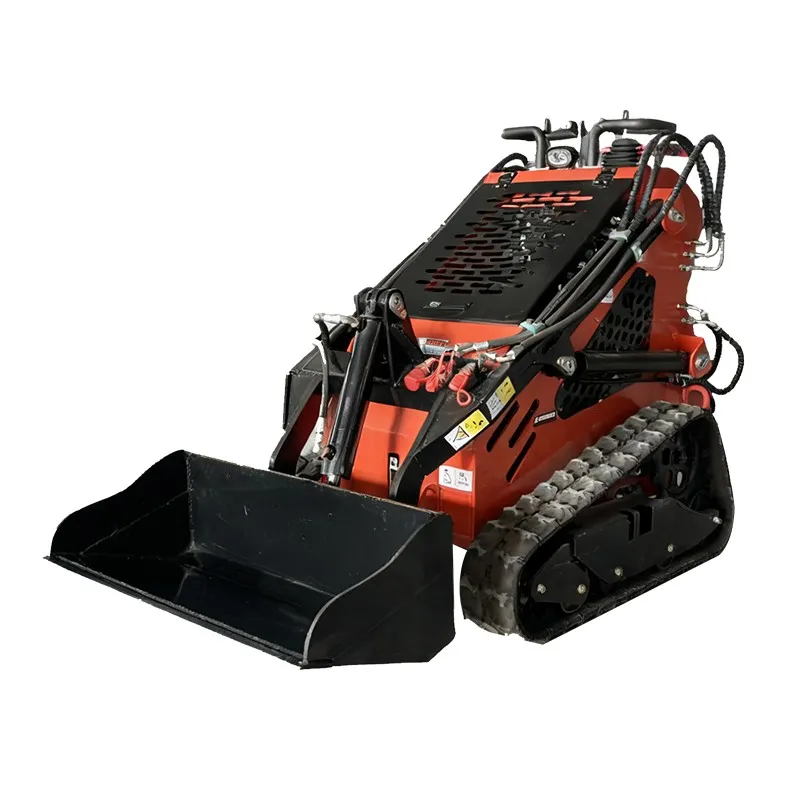
When most folks hear 'advantages of a compact track loader', they jump straight to the low ground pressure and stability. Sure, that's textbook. But after years on sites, from muddy residential backyards to tight demo jobs, I've found the real advantages are more nuanced, often hiding in the operational gaps that spec sheets don't cover. It's not just about what it is, but what it lets you do—or stop worrying about.
The Traction Myth and the Reality of Go-Anywhere
Everyone sells the undercarriage as the magic bullet. Less ground pressure than wheels, yes. But the real advantage isn't just floating over mud; it's about predictable traction in inconsistent conditions. I remember using a wheeled skid steer on a site that started dry but turned slick after rain. Spinning, digging in, tearing up the client's lawn—a mess. Switched to a CTL the next day, a model similar to what Shandong Pioneer Engineering Machinery Co., Ltd exports, and the difference was operational calm. It wasn't faster, but it was consistently productive. No sudden loss of grip, no frantic counter-steering. That consistency over a full shift, knowing the machine will do what you ask without surprise, is a massive, often unquantified advantage.
This leads to another point: surface preservation. It's not just about not sinking. On delicate surfaces like asphalt or finished grades, the distributed weight prevents those ugly scuff marks and pressure cracks that wheels can leave. You avoid costly repair work you didn't budget for. I've seen contractors lose a big chunk of their profit fixing a driveway they damaged during landscaping. A CTL, with its proper track system, mitigates that risk substantially.
There's a caveat, though—the tracks themselves. They're an advantage until they wear or get damaged. Picking up rebar, working in rocky demolition... a torn track can shut you down. The advantage hinges on maintenance and situational awareness. You can't just drive over anything blindly. The machine's capability requires a more attentive operator, someone who reads the terrain, not just the joysticks.
Stability as a Productivity Tool, Not Just a Safety Feature
Manufacturers love to show CTLs on slopes. The stability advantage is clear. But from an operator's seat, that stability translates directly into confidence and, therefore, speed. When you're not constantly fighting a tippy feeling, especially with a loaded bucket raised, you can place material more accurately and cycle faster. You're not inching along; you're working. This is huge for tasks like backfilling trenches or loading trucks on uneven ground.
I think of a site where we were using a CTL to move pallets of pavers on a slight slope. The wheeled machine we had before would list noticeably, making the operator hesitant to lift full loads to height. The CTL's stable platform meant the operator could run at full capacity without that subconscious hesitation. The job finished a half-day early. That's an advantage you feel in your schedule and your bottom line.
This stability also extends to attachment performance. Take a planer or a trencher. A jittery, unstable carrier ruins the quality of the work. The CTL's planted stance provides a solid foundation for these precision attachments, giving you a cleaner cut, a straighter trench. The advantage isn't the loader alone; it's the quality of work the enabled attachment can now produce.
The Hidden Cost Advantage: Downtime and Durability
Here's where experience talks. The upfront cost is higher than a wheeled machine. So, where's the ROI? It's in reduced downtime and longer life in harsh conditions. Wheels and tires are perpetual cost centers—flats, wear, replacements. On a busy site, a flat tire can waste hours. Tracks, while a bigger ticket item to replace, often last longer under sustained abrasive use. Your downtime events are fewer, though potentially longer when they happen. It's a different risk profile.
We ran a pair of machines on a long-term site—one wheeled, one tracked. The wheeled machine averaged a tire issue every couple of weeks (punctures, sidewall cuts). The tracked machine needed track tension adjustments and routine inspection, but its first major undercarriage service came much later. The tracked machine's total cost of ownership over that project was arguably better. For a company like Shandong Pioneer, which exports globally to markets like the US and Australia, this durability is key. Their customers need machines that can withstand varied, often remote job sites without constant support.
There's also a dealer and support aspect. A reliable undercarriage from a reputable manufacturer means fewer emergency calls. The advantage is logistical peace of mind. Knowing you have a robust machine, perhaps from a supplier with two decades of development like Pioneer, which started in 2004 and recently expanded its facilities, allows you to bid on tougher jobs with more confidence.
Versatility and the One Machine Fallacy
The CTL is hailed as the ultimate versatile tool carrier. And it is. The combination of traction, stability, and hydraulic power makes it a beast with dozens of attachments. But the advantage has limits that are rarely discussed. Not all CTLs are created equal. The auxiliary hydraulic flow and pressure are critical. A machine with low flow might run a broom fine but choke a cold planer or a forestry mulcher, turning an advantage into a frustration.
I learned this the hard way trying to run a heavy-duty mulcher on a standard-flow CTL. It worked, but slowly, constantly bogging down. The job was inefficient. The real advantage comes from matching the machine's capabilities to your primary tasks. If you're mainly mulching or milling, you need a high-flow model. The versatility advantage is only realized with the right specs.
That said, for general contracting, the ability to switch from a bucket to a auger to a trencher to a grapple in a day is transformative. It reduces the need for multiple dedicated machines, saving on transport, insurance, and operator costs. This is where the CTL truly shines—as a mobile, adaptable power pack on smaller or multi-phase sites.
The Operator Factor: Comfort and Control
This might be the most underrated advantage. A stable, capable machine reduces operator fatigue. Less vibration, less rocking, less mental energy spent on not tipping over. Over a 10-hour day, that means a more alert, productive operator. The cab environment in modern CTLs, with better suspension and climate control, adds to this. A comfortable operator is a safe and efficient operator.
Also, the control scheme—often hand-operated with ISO patterns—allows for precise, simultaneous movements. When you're grading or doing fine backfill work, this precision, combined with the machine's inherent stability, lets you achieve finish-grade results that might otherwise require a dedicated tool. You're not just moving dirt; you're shaping it.
But this advantage is contingent on training. Handing the keys of a powerful CTL to an inexperienced operator can erase all its benefits quickly. Tracks can still tear up ground if spun aggressively. The stability can create a false sense of security on extreme slopes. The machine enables skill but doesn't replace it.
Conclusion: The Context-Dependent Champion
So, are compact track loaders advantageous? Absolutely. But not universally. Their core advantages—superior traction, planted stability, durability in rough conditions, and enabled versatility—make them champions on soft, uneven, or sensitive terrain and for precision attachment work. For a firm working on paved surfaces or hard, dry ground most of the time, a wheeled machine might be more cost-effective.
The key is to assess your typical work environment, your primary attachments, and your operational style. The advantage isn't in a brochure; it's in the machine's fit to your daily grind. From what I've seen, for contractors facing diverse, unpredictable site conditions, the CTL's blend of capabilities offers a reliability that goes beyond specs. It's the machine that often just... works, letting you focus on the job, not the machine. And in this business, that's the ultimate advantage.
Related Products
Related Products