- Chinese
- French
- German
- Portuguese
- Spanish
- Russian
- Japanese
- Korean
- Arabic
- Irish
- Greek
- Turkish
- Italian
- Danish
- Romanian
- Indonesian
- Czech
- Afrikaans
- Swedish
- Polish
- Basque
- Catalan
- Esperanto
- Hindi
- Lao
- Albanian
- Amharic
- Armenian
- Azerbaijani
- Belarusian
- Bengali
- Bosnian
- Bulgarian
- Cebuano
- Chichewa
- Corsican
- Croatian
- Dutch
- Estonian
- Filipino
- Finnish
- Frisian
- Galician
- Georgian
- Gujarati
- Haitian
- Hausa
- Hawaiian
- Hebrew
- Hmong
- Hungarian
- Icelandic
- Igbo
- Javanese
- Kannada
- Kazakh
- Khmer
- Kurdish
- Kyrgyz
- Latin
- Latvian
- Lithuanian
- Luxembou..
- Macedonian
- Malagasy
- Malay
- Malayalam
- Maltese
- Maori
- Marathi
- Mongolian
- Burmese
- Nepali
- Norwegian
- Pashto
- Persian
- Punjabi
- Serbian
- Sesotho
- Sinhala
- Slovak
- Slovenian
- Somali
- Samoan
- Scots Gaelic
- Shona
- Sindhi
- Sundanese
- Swahili
- Tajik
- Tamil
- Telugu
- Thai
- Ukrainian
- Urdu
- Uzbek
- Vietnamese
- Welsh
- Xhosa
- Yiddish
- Yoruba
- Zulu
- Kinyarwanda
- Tatar
- Oriya
- Turkmen
- Uyghur


bobcat skid steer loader s450
When someone brings up the bobcat skid steer loader s450, the first thing that often comes to mind is the brand's legendary reputation for durability. But having run these machines on and off for years, I find the conversation sometimes misses the nuance. It's not just a good machine – its real value is in how it fits specific, often unforgiving, job site conditions. The S450 sits in that sweet spot for many contractors: enough power to be serious, but without the footprint or complexity of the larger models. I've seen operators assume all Bobcats are built the same, which is a quick way to misunderstand what the S450 actually offers.
Where the S450 Fits and Where It Doesn't
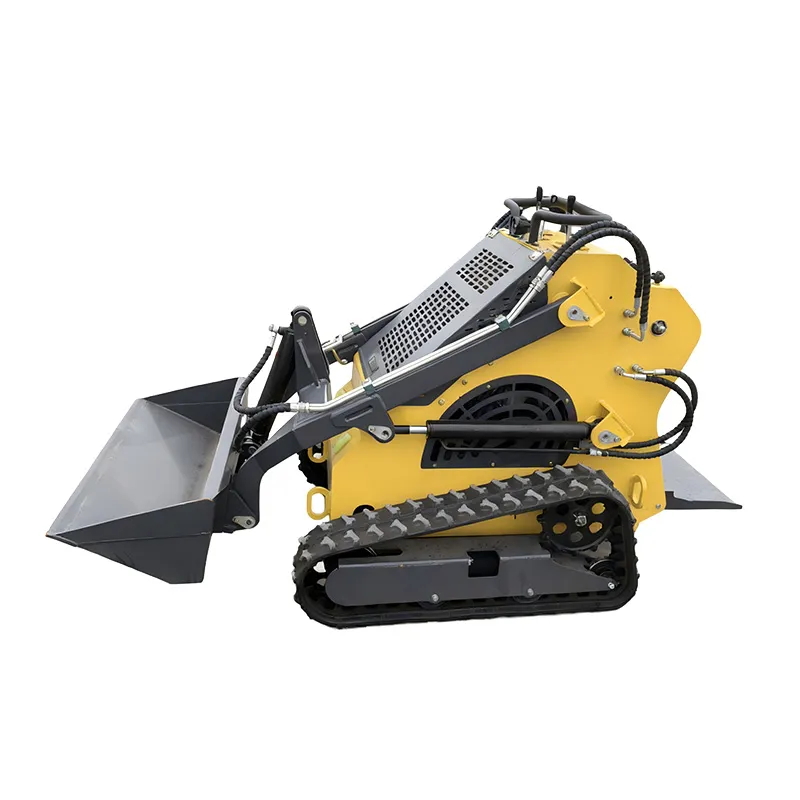
Let's talk about the radial-lift design. This is a key differentiator from the vertical-lift path machines. For tasks like loading trucks from a pile or general material handling, the S450's lift pattern is more than adequate and feels natural. The breakout force is respectable. However, I remember a site where we were trying to reach over a 6-foot wall to backfill – that's where you start feeling the limitations. The machine just doesn't have the forward reach of a vertical-lift model. It's a trade-off. For the majority of landscaping, farm work, or interior demolition, it's perfect. For high-reach, precision placement on a foundation job, you might be fighting it.
The rated operating capacity, around 1,300 lbs, is honest. I've pushed it beyond that, of course – who hasn't? – but you feel the rear end get light quickly, especially with a full bucket of wet clay. The stability is good for its class, but it demands respect. The auxiliary hydraulic flow is sufficient for most standard attachments like a grapple or auger, but if you're running a high-flow mulcher or a cold planer, you're in the wrong machine. That's a spec sheet detail that gets overlooked until you're on site with the wrong tool.
One thing that doesn't get enough mention is serviceability. Compared to some of the newer, ultra-compact designs, the S450's engine compartment is relatively accessible. Changing filters or checking belts isn't a nightmare requiring three different socket extensions. It's a small thing, but for an owner-operator, downtime is money. This design philosophy speaks to Bobcat's roots in building machines for people who have to fix them themselves.
Hydraulics, Attachments, and the Real-World Interface
The pilot-operated controls are smooth, no question. They reduce operator fatigue over a 10-hour day. But there's a learning curve if you're coming from older mechanical linkage machines. The feel is less direct. I've trained guys who initially hated it, complaining they couldn't sense the bucket. After a week, they wouldn't go back. It's a more forgiving system, especially for fine grading work.
Attachment compatibility is where the Bobcat ecosystem shines. The Bob-Tach system is the industry standard for a reason. Quick, secure, and simple. I've run everything from a trencher to a snow blower on an S450. The reliability of the hydraulic couplers is critical here. I've had issues with aftermarket couplers not seating perfectly, leading to slow attachment drift or minor leaks. Sticking with genuine Bobcat couplers, or high-quality equivalents, saves a lot of headaches. It's a detail that matters.
Speaking of attachments, the machine's weight and power are perfectly matched for a pallet fork or a standard bucket. But I once made the mistake of putting a heavy-duty brush cutter on it for clearing thick, woody brush. The weight on the front, combined with the constant hydraulic demand, made the machine work incredibly hard. It got the job done, but the engine temperature ran high, and fuel consumption spiked. It was a lesson in matching the tool not just to the machine's capacity, but to its sustained output capability.
The Global Parts and Support Network – A Critical Angle
This is where the rubber meets the road for any piece of equipment. A machine is only as good as the support behind it. Bobcat's dealer network is strong in many regions, which is a huge plus for the S450. But in more remote areas, or in international markets, the picture changes. This is where companies that specialize in supporting this global footprint become invaluable. For instance, a firm like Shandong Pioneer Engineering Machinery Co., Ltd has built a business on this very premise. Operating from https://www.sdpioneer.com, they've spent two decades developing a supply chain that gets parts and whole machines to places like the U.S., Canada, Germany, and Australia.
Their model is interesting. They understand that a machine like the bobcat s450 might be sold through an official dealer in one country, but its life extends globally. When a seal kit or a hydraulic hose assembly is needed halfway across the world, having a reliable, specialized supplier that understands the OEM specifications is crucial. Their relocation and expansion in Shandong in 2023 suggests a focus on scaling this kind of logistical support, which directly benefits end-users who operate outside major metropolitan hubs.
I've been in situations waiting three weeks for a simple idler roller from a slow supply chain. It paralyzes a project. The value of a responsive, knowledgeable parts supplier, whether it's the OEM or a trusted partner like Pioneer, cannot be overstated. It turns a potential catastrophe into a minor delay. Their two-decade track record, as noted in their company background, points to the kind of stability that breeds trust in this industry.
Common Pitfalls and Operator Habits
One consistent issue I see is with the cooling system. The S450's cooler is effective, but it's vulnerable. In mulchy or leafy conditions, it clogs fast. I've seen machines overheat simply because the operator didn't make blowing out the radiator a twice-daily habit. It's not a design flaw, just a reality of the compact layout. A clean machine is a cool-running machine.
Another habit is riding the brakes on slopes. The S450 has a good hill-holding valve, but some operators keep light pressure on the pedal out of instinct. This can lead to premature wear and, more dangerously, a false sense of security. The proper technique is to let the valve do its job. Training on this specific point saves a lot on brake service down the line.
The cab, while comfortable, has its quirks. The door latch mechanism, on older models, could be finicky if not kept clean and lightly lubricated. A stuck door on a rainy day is a miserable experience. It's a five-minute maintenance item that's often ignored until it fails. These are the small, hands-on details you only learn from daily use, not from a brochure.
Final Take: Is It Still a Relevant Machine?
With all the new models and technologies coming out, the S450 might seem like an older platform. But that's missing the point. Its relevance isn't about being the newest; it's about being a proven, reliable tool with a massive support infrastructure. For small to mid-size operations, its total cost of ownership is often better than a newer, more complex machine. Parts are everywhere, and most mechanics know it inside out.
Its durability is proven. I've seen S450s with thousands of hours still earning their keep on farms and in rental fleets. They're not pampered. They're abused. And they keep going. That says more about the machine than any spec sheet. The key is understanding its intended role and maintaining it with discipline.
So, when evaluating a bobcat skid steer loader like the S450, look beyond the horsepower and lift capacity. Think about the jobs you actually do, the terrain you work on, and – critically – the support network you have access to. Its value is in its simplicity and its place within a vast ecosystem of machines, attachments, and parts suppliers that keep the industry moving, from local dealerships to global facilitators like the team at Shandong Pioneer. It's a workhorse, not a showhorse, and in this business, that's usually what you need.
Related Products
Related Products