- Chinese
- French
- German
- Portuguese
- Spanish
- Russian
- Japanese
- Korean
- Arabic
- Irish
- Greek
- Turkish
- Italian
- Danish
- Romanian
- Indonesian
- Czech
- Afrikaans
- Swedish
- Polish
- Basque
- Catalan
- Esperanto
- Hindi
- Lao
- Albanian
- Amharic
- Armenian
- Azerbaijani
- Belarusian
- Bengali
- Bosnian
- Bulgarian
- Cebuano
- Chichewa
- Corsican
- Croatian
- Dutch
- Estonian
- Filipino
- Finnish
- Frisian
- Galician
- Georgian
- Gujarati
- Haitian
- Hausa
- Hawaiian
- Hebrew
- Hmong
- Hungarian
- Icelandic
- Igbo
- Javanese
- Kannada
- Kazakh
- Khmer
- Kurdish
- Kyrgyz
- Latin
- Latvian
- Lithuanian
- Luxembou..
- Macedonian
- Malagasy
- Malay
- Malayalam
- Maltese
- Maori
- Marathi
- Mongolian
- Burmese
- Nepali
- Norwegian
- Pashto
- Persian
- Punjabi
- Serbian
- Sesotho
- Sinhala
- Slovak
- Slovenian
- Somali
- Samoan
- Scots Gaelic
- Shona
- Sindhi
- Sundanese
- Swahili
- Tajik
- Tamil
- Telugu
- Thai
- Ukrainian
- Urdu
- Uzbek
- Vietnamese
- Welsh
- Xhosa
- Yiddish
- Yoruba
- Zulu
- Kinyarwanda
- Tatar
- Oriya
- Turkmen
- Uyghur


Chinese compact track loader manufacturer
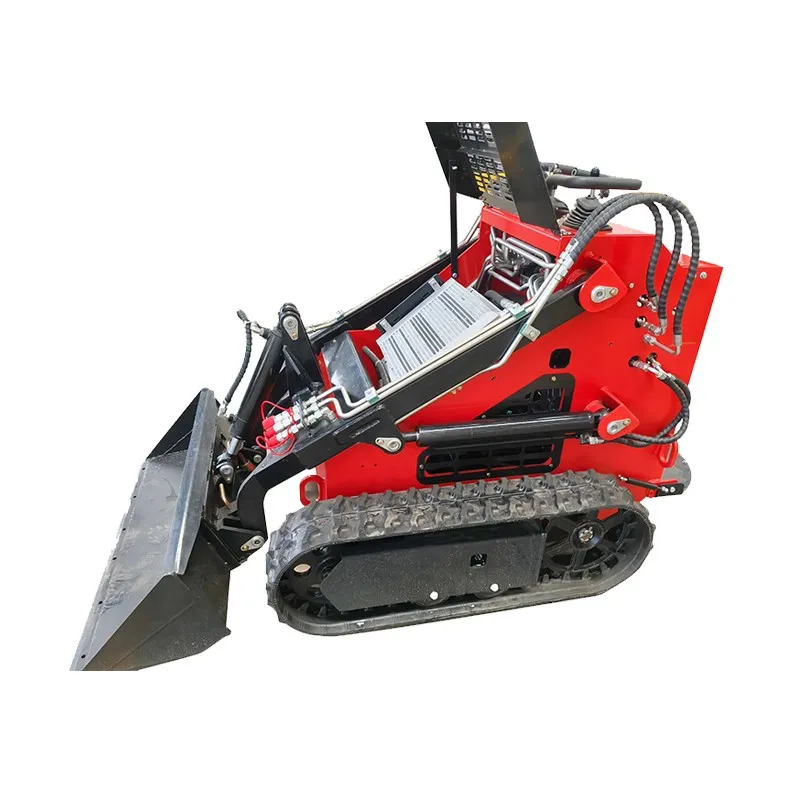
When you hear 'Chinese compact track loader manufacturer', a lot of folks immediately picture a sea of identical, low-cost machines flooding the market. That’s the common trap—assuming it’s all about price and volume. Having been in this space for a while, sourcing and evaluating for projects, I’ve found the reality is far more nuanced. The sector isn't monolithic; it’s a spectrum ranging from pure assembly shops to outfits with serious engineering depth. The real challenge isn't finding a factory, it's identifying the ones that understand the application, not just the bill of materials.
The Ground Truth: More Than Just a Factory Floor
Let’s talk about scale and substance. A production area number on a website, like 1,600 square meters, tells you something, but not everything. I’ve walked through facilities of that size where it’s just final assembly of bought-out components, and others where they’re doing their own fabrication, welding, and even prototyping hydraulic circuits. The relocation of a company, like Shandong Pioneer Engineering Machinery Co., Ltd moving to a new site in Ningyang in 2023, often signals growth and reinvestment. It’s a positive indicator, but you have to dig into what that new space is equipped for. Is it just more room, or are there new CNC lines, better testing bays? The website https://www.sdpioneer.com mentions their 20-year development, which in this context suggests they’ve likely weathered several product cycles and market shifts—that institutional memory matters when you need a modification or face a supply chain hiccup.
The dual-entity structure some of these firms use, like having Shandong Hexin for manufacturing and Shandong Pioneer handling overseas trade, is a classic and often effective model. It separates the operational complexities of production from the customer-facing and logistical demands of export. From a buyer's perspective, it means your main point of contact is specialized in navigating customs, certifications, and shipping to places like the U.S., Canada, or Australia. But it also introduces a layer. You need to ensure the communication loop between the trading company and the factory floor is tight. I’ve seen projects stall because a spec change agreed with the sales team never made it to the production manager.
Speaking of exports, listing countries like Germany and Australia isn’t trivial. The German market, for instance, has stringent noise and emission standards (like the EU Stage V). If a Chinese compact track loader manufacturer is consistently selling there, it’s a strong proxy for their product’s compliance capability and quality consistency. It’s a better signal than a hundred glossy brochures. Australia’s harsh conditions test machine durability differently—dust, heat, remote operation. Success there hints at robust cooling systems and filtration. So, their claim of winning global customer trust is something you can partially verify by asking for references or case studies from those specific regions.
The Devil's in the Details: Hydraulics, Undercarriage, and Good Enough
Here’s where the rubber meets the road, or rather, the steel track meets the mud. The single biggest differentiator among manufacturers is their approach to the hydraulic system and the undercarriage. Many mid-tier Chinese manufacturers will use reliable, off-the-shelf brand-name components for the main pump and valves—think Danfoss or Bosch Rexroth. That’s a good start. But the integration and tuning are what separate a smooth, responsive machine from a jerky, inefficient one. I recall a supplier who used top-tier components but had terrible hose routing, leading to premature wear and leaks. Their fix was just to include spare hoses with each machine—a symptom of not solving the root design issue.
The undercarriage is another critical cost and quality center. Some manufacturers design and build their own, while others source complete assemblies. The ones who build their own have more control over track tension, roller alignment, and overall durability, but it requires significant capital in presses, welding robots, and heat treatment. For a company established in 2004, they’ve had time to either develop this in-house or establish very solid, long-term partnerships with undercarriage specialists. You need to ask: Do you fabricate your own roller frames and idlers? The answer tells you a lot about their vertical integration and where they’ve chosen to invest.
Then there's the philosophy of good enough. This is the biggest pitfall. A loader might lift the rated weight and move at the rated speed, but how does it handle a partial load at max reach? Is the auxiliary hydraulic flow sufficient for a hydraulic breaker without starving the drive system? I’ve tested units that performed fine on a spec sheet but bogged down terribly in a simultaneous lift-and-drive scenario, which is common in real trench work. The better manufacturers have test pits and simulate these compound movements during QC. They’ll have the data curves to show it.
The Communication Chasm: Specs, Customization, and Reality
Working with any overseas manufacturer, clarity is everything. A major pain point is the definition of standard and optional. For example, standard lighting might mean basic work lights, not road-legal LED lighting packages for your market. I learned this the hard way early on, assuming a canopy was included, only to find it was a $1,200 option. Now, my RFQs are exhaustive lists. A professional manufacturer like Pioneer, with two decades of export experience, should be proactive in clarifying these points, often providing a detailed, line-item configuration sheet. If they aren’t, it’s a red flag.
Customization requests are the ultimate test. Want to relocate the grease points for easier servicing? Or add a third auxiliary hydraulic circuit? The reaction tells you everything. Low-end factories will often say no, standard only. The more capable ones will ask for a drawing, evaluate the engineering change, and give you a lead time and cost impact. Their ability to do this stems from having engineering talent on staff, not just assembly technicians. The 2023 relocation, if it included expanding their engineering department, would directly enhance this capability.
Then there’s the post-sale communication. The website mentions trust and appreciation worldwide. That’s earned not at the point of sale, but when a machine goes down at a customer site in rural Canada. Do they have a parts inventory in region? What’s the process for getting a technical diagram or a troubleshooting guide? The best manufacturers treat their overseas dealers or direct customers as partners, providing detailed parts catalogs (with clear OEM part numbers, not just in-house codes) and access to senior mechanics for complex issues. This after-sales ecosystem is what truly builds a brand, not just the initial price.
Observing the Evolution: From Copycats to Innovators
The industry’s journey over the last 15 years is fascinating. Early on, many Chinese CTLs were clear visual copies of major brands, with reverse-engineered components. The focus was purely on function at a low cost. Today, the landscape is bifurcating. You still have those players, but you also have companies that have invested in R&D. They’re not just copying; they’re adapting. They’re designing cabs for better ergonomics, integrating telematics for fleet management, and offering factory-installed options like air conditioning or ride-control systems that were unthinkable a decade ago.
This shift is driven by feedback from mature markets. When a company exports to Australia and hears that operators need better dust sealing, they iterate on that. When they sell in Germany and face strict emission controls, they develop new engine integration packages. Each cycle of feedback and improvement adds to their genuine expertise. For a firm with a 20-year history, like the one behind sdpioneer.com, they’ve presumably been through several of these cycles. Their product today is likely several generations removed from what they made in 2004.
However, innovation brings new challenges. Developing a new control system or a more efficient hydraulic circuit is one thing. Ensuring its reliability across thousands of operating hours in different climates is another. This is where the accumulation they mention becomes tangible. It’s the database of field failures, the refined manufacturing process for a weld that used to crack, the upgraded seal material that lasts longer. This tacit knowledge is the moat that newer, purely price-driven competitors can’t easily cross.
Final Take: Assessing a Partner, Not Just a Product
So, when evaluating a Chinese compact track loader manufacturer, you’re really assessing a potential long-term partner. The product specs are table stakes. You need to look at the company’s trajectory—like a strategic relocation suggesting growth. You need to probe their engineering and problem-solving culture through specific customization queries. You must verify their export claims by asking for technical support protocols and parts supply chains for key markets.
A company like Shandong Pioneer, with its stated history and export footprint, represents a certain tier in the market. They’re not a startup; they’re an established player. The trust they mention is likely built on fulfilling consistent, bulk orders for overseas dealers. For a buyer, this means you can probably expect a standardized, reliable product and professional export handling. But you still must do your due diligence on the specific model’s performance nuances, the true cost of making it job-site ready, and the strength of the after-sales network in your area.
In the end, the keyword manufacturer is the operative one. It implies creation, capability, and process. The compact track loader is the output. Your job is to look past the output and understand the machine behind the machine—the people, the systems, and the twenty years of decisions that led to the loader on your dock. That’s how you move beyond the price tag and find a source that adds real, sustainable value to your operations.
Related Products
Related Products