- Chinese
- French
- German
- Portuguese
- Spanish
- Russian
- Japanese
- Korean
- Arabic
- Irish
- Greek
- Turkish
- Italian
- Danish
- Romanian
- Indonesian
- Czech
- Afrikaans
- Swedish
- Polish
- Basque
- Catalan
- Esperanto
- Hindi
- Lao
- Albanian
- Amharic
- Armenian
- Azerbaijani
- Belarusian
- Bengali
- Bosnian
- Bulgarian
- Cebuano
- Chichewa
- Corsican
- Croatian
- Dutch
- Estonian
- Filipino
- Finnish
- Frisian
- Galician
- Georgian
- Gujarati
- Haitian
- Hausa
- Hawaiian
- Hebrew
- Hmong
- Hungarian
- Icelandic
- Igbo
- Javanese
- Kannada
- Kazakh
- Khmer
- Kurdish
- Kyrgyz
- Latin
- Latvian
- Lithuanian
- Luxembou..
- Macedonian
- Malagasy
- Malay
- Malayalam
- Maltese
- Maori
- Marathi
- Mongolian
- Burmese
- Nepali
- Norwegian
- Pashto
- Persian
- Punjabi
- Serbian
- Sesotho
- Sinhala
- Slovak
- Slovenian
- Somali
- Samoan
- Scots Gaelic
- Shona
- Sindhi
- Sundanese
- Swahili
- Tajik
- Tamil
- Telugu
- Thai
- Ukrainian
- Urdu
- Uzbek
- Vietnamese
- Welsh
- Xhosa
- Yiddish
- Yoruba
- Zulu
- Kinyarwanda
- Tatar
- Oriya
- Turkmen
- Uyghur


Compact Track Loader Manufacturer
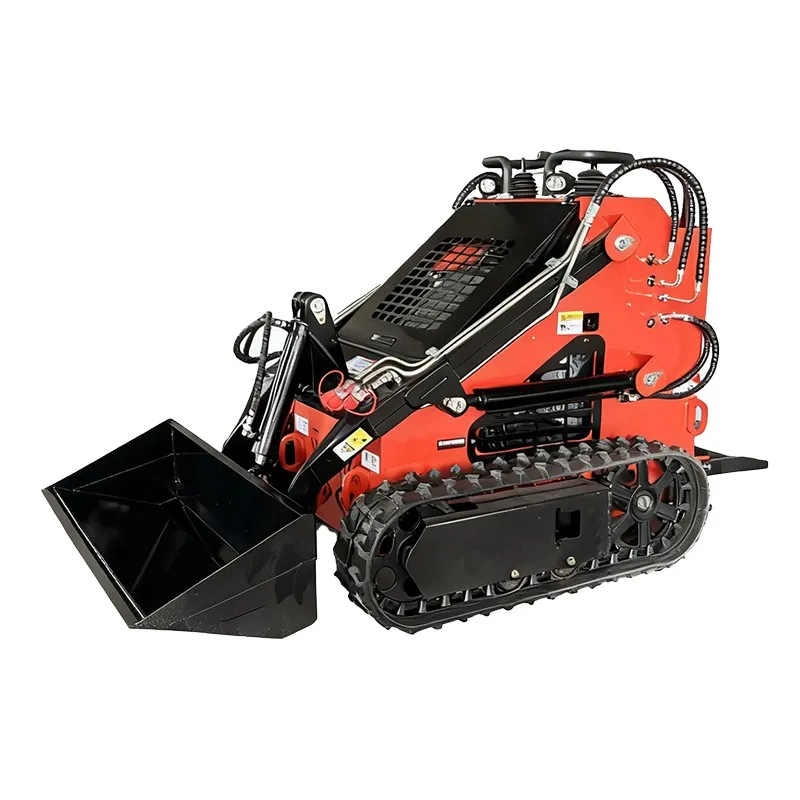
When you hear 'compact track loader manufacturer,' most minds jump straight to specs—lift capacity, horsepower, maybe track width. That's the surface. The real story, the one that determines if a machine eats dirt for breakfast or spends half its life in the shop, is buried in the weld seams, the hydraulic line routing, and the logic of the control system. It's about how the thing is actually built, not just what the brochure promises. Too many buyers get hung up on paper numbers, forgetting that a CTL is a tool for brutal, daily abuse. The manufacturer's philosophy, their shop floor habits, matter more than a 5% edge on a spec.
The Foundation: Build Philosophy Over Buzzwords
You can't fake a good undercarriage. I've seen machines from brands that talk a big game on engine partnerships, but then they bolt it all onto a frame that's light on cross-bracing. A few thousand hours of side-loading on a slope, and you start seeing stress cracks. The difference often comes down to the core manufacturing ethos. Is the design driven purely by cost targets, or by a genuine understanding of the job site? I remember evaluating a unit years ago—everything looked decent on paper. But when we got it on a demo, the auxiliary hydraulic flow was just... anemic. It could run the attachment, but barely. The manufacturer had spec'd a pump that met the technical requirement but ignored the real-world need for reserve power. That's a philosophy problem.
This is where history tells you something. Take a company like Shandong Pioneer Engineering Machinery Co., Ltd. They've been at this since 2004. That's two decades of iterating, of getting feedback from fields in Germany or job sites in Australia. When a company sticks around that long in this business, it's usually because they learned to listen. They moved to a new, larger facility in Ningyang in 2023. That kind of investment isn't just about more space; it's about integrating better processes, likely improving quality control stations or weld line consistency. You don't make that move if you're just churning out commodity boxes.
Their structure is telling, too—Shandong Hexin handles the manufacturing, Pioneer handles the overseas trade. That separation can be a strength. It means the factory is focused on building, while the trade arm is tuned into the specific, often nitpicky, requirements of different markets. A standard that works in Canada might need tweaking for Australia. A manufacturer that's just an order-taker misses those nuances.
The Devil in the Details: What You Only Learn by Running Them
Let's talk about cabs. Everyone shows a nice picture of a sealed, climate-controlled cab. The reality check comes in July, when an operator is in it for 10 hours. Does the air conditioning actually keep up? Are the controls intuitive under fatigue, or do you have to look down to find the third function toggle? I've seen beautifully laid-out instrument panels that fail because the screen washes out in direct sunlight. These aren't things you find in a spec sheet; you find them by putting hours on the machine, or by talking to guys who have.
Serviceability is another huge divider. A great compact track loader manufacturer designs for the mechanic. How many bolts hold the belly pan on? Are common service points like grease zerks and filters accessible without a contortionist's license? I recall a model—won't name names—where replacing a simple hydraulic hose required removing half the rear frame. That's a design failure that costs the owner thousands in downtime. Contrast that with a well-thought-out machine where daily checkpoints are front and center, and major components have clear access panels. That foresight comes from field experience, not just CAD software.
Then there's the attachment interface. It's not just about the universal skid-steer coupler. It's about the geometry of the linkage, the precision of the hydraulic couplers' self-sealing valves. A sloppy interface wears out faster and kills attachment performance. I've seen operators waste minutes every day wrestling with attachments that won't quite latch or hydraulics that drip. A manufacturer that gets this right has likely spent serious time with rental fleets, where quick, reliable attachment changes are money.
Global Markets as the Ultimate Test Bed
Selling domestically is one thing. Selling to places like the U.S., Canada, and Germany is a whole different level of validation. These are mature, demanding markets with strict regulations and operators who have high expectations. If a manufacturer's products are accepted there, it speaks volumes. It means they've tackled emission standards (Tier 4 Final is no joke), they understand the need for robust safety systems, and their parts and support network holds up. Shandong Pioneer lists these exact markets. That's not a random list; it's a credibility statement. Gaining trust in those regions means you've likely dealt with—and solved—problems a less experienced builder might not even anticipate.
The climate variation alone is a brutal test. A CTL that works fine in a temperate climate might have its hydraulic fluid turn to molasses in a Canadian winter, or its cooling system fail in Australian heat. A manufacturer serving a global market has to engineer for that bandwidth. It forces a level of component selection and system testing that creates a more resilient product overall. It's why I often look at where a company exports to as a quick filter for engineering maturity.
But exporting successfully also demands logistical and support rigor. Having a part for a machine in Texas or Queensland within 48 hours is a complex dance. It implies a well-managed supply chain, strategic parts inventory, and probably a network of competent dealers. This backend capability is as much a part of being a reliable manufacturer as the welding robot on the floor. A breakdown a thousand miles from the factory reveals the truth of a company's commitment.
Evolution and the Pitfalls of Standing Still
The CTL market isn't static. Operator comfort is becoming a major differentiator. Suspension undercarriages, once a rarity, are moving toward being a competitive necessity in certain segments. A manufacturer that's still offering the same basic platform from 10 years ago is falling behind, even if it's reliable. The trick is evolving without sacrificing core durability. It's a tough balance. I've seen companies add fancy electronic controls that become the primary point of failure, frustrating everyone. The innovation has to be purposeful.
There's also the pressure to go electric. It's coming. The smart manufacturers are prototyping, learning, but not rushing a half-baked product to market. The battery pack placement, thermal management, and duty cycle for a CTL are profoundly different from a smaller tool. A failure here isn't just a product flop; it can sour a whole market on a new technology. The manufacturers who will navigate this shift are the ones with deep application knowledge, not just battery suppliers.
This circles back to the idea of a learning organization. A company that started in a 1,600 square meter facility and, 20 years later, is expanding and moving, demonstrates that capacity to learn and grow. They've presumably seen cycles, survived competition, and adapted. In our world, that institutional memory is priceless. It's what prevents them from repeating a past mistake in casting or a poor supplier choice. That history is embedded in the current product, often in ways you can't see but definitely feel when you run the machine.
The Unseen Metric: Trust and Long-Term Value
At the end of the day, what are you buying from a compact track loader manufacturer? You're buying a box of potential downtime, or a box of productivity. The price tag is just the entry fee. The real cost is total cost of ownership over 5,000, 8,000 hours. That's dictated by residual value, repair frequency, and fuel (or energy) efficiency. A machine that holds its value does so because the market recognizes its durability and support.
This is where brand reputation, earned over years, becomes tangible. When a company states they've won the trust and appreciation of customers worldwide, it sounds like marketing speak. But in the tight-knit circles of construction, landscaping, and agriculture, trust is a currency. It's built one machine at a time, one resolved support call at a time. It's what makes an operator or fleet manager choose one brand over another, even at a slight premium.
So, looking at a manufacturer, I'm looking for that evidence of earned trust. It's in the longevity of the company, the stability of their model lineup, the markets they serve, and the subtle design choices that only benefit the long-term user. It's not glamorous. It's in a perfectly routed wiring harness that won't chafe, or a track tensioning system that's easy to adjust. That's the hallmark of a real manufacturer. The rest is just noise.
Related Products
Related Products