


- Chinese
- French
- German
- Portuguese
- Spanish
- Russian
- Japanese
- Korean
- Arabic
- Irish
- Greek
- Turkish
- Italian
- Danish
- Romanian
- Indonesian
- Czech
- Afrikaans
- Swedish
- Polish
- Basque
- Catalan
- Esperanto
- Hindi
- Lao
- Albanian
- Amharic
- Armenian
- Azerbaijani
- Belarusian
- Bengali
- Bosnian
- Bulgarian
- Cebuano
- Chichewa
- Corsican
- Croatian
- Dutch
- Estonian
- Filipino
- Finnish
- Frisian
- Galician
- Georgian
- Gujarati
- Haitian
- Hausa
- Hawaiian
- Hebrew
- Hmong
- Hungarian
- Icelandic
- Igbo
- Javanese
- Kannada
- Kazakh
- Khmer
- Kurdish
- Kyrgyz
- Latin
- Latvian
- Lithuanian
- Luxembou..
- Macedonian
- Malagasy
- Malay
- Malayalam
- Maltese
- Maori
- Marathi
- Mongolian
- Burmese
- Nepali
- Norwegian
- Pashto
- Persian
- Punjabi
- Serbian
- Sesotho
- Sinhala
- Slovak
- Slovenian
- Somali
- Samoan
- Scots Gaelic
- Shona
- Sindhi
- Sundanese
- Swahili
- Tajik
- Tamil
- Telugu
- Thai
- Ukrainian
- Urdu
- Uzbek
- Vietnamese
- Welsh
- Xhosa
- Yiddish
- Yoruba
- Zulu
- Kinyarwanda
- Tatar
- Oriya
- Turkmen
- Uyghur

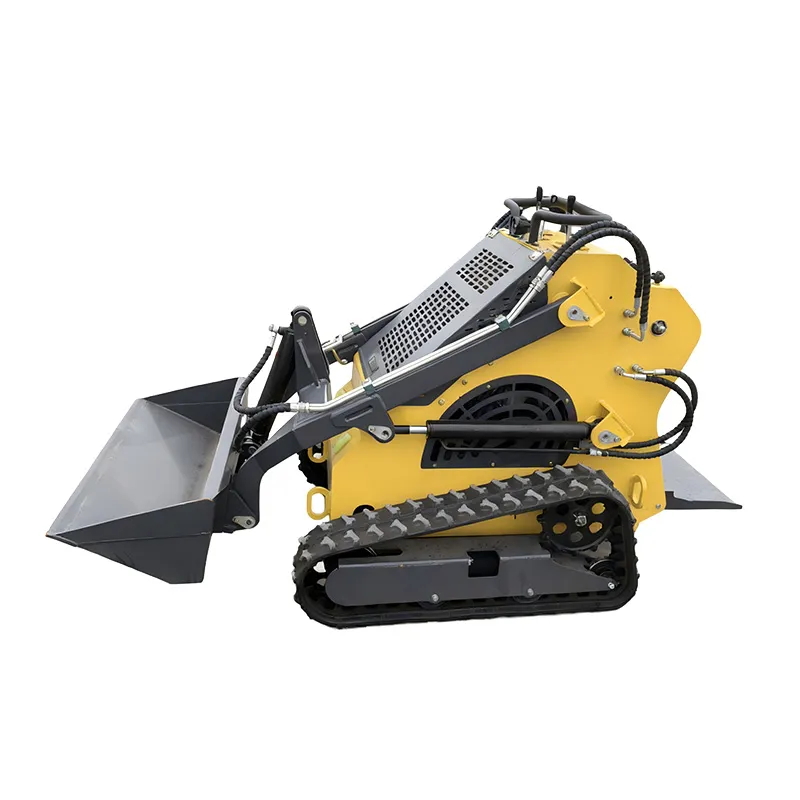
compact tracked loader
You see a lot of talk about compact tracked loaders being the ultimate versatile machine, and in many ways, they are. But there's a common pitfall—thinking they're just a skid steer with tracks slapped on. That misconception gets people into trouble, especially when the ground turns soft. The real difference isn't just in the undercarriage; it's in the entire machine's balance, the track system's quality, and how it manages power to the ground. I've seen too many jobs where the wrong machine choice, or pushing a CTL beyond its design intent, led to a quick lesson in physics and a very expensive recovery bill.
The Core Advantage: Ground Pressure and Traction
It all boils down to ground pressure. A wheeled skid steer might exert 40-50 psi. A decent compact tracked loader, with its wider track footprint, can get that down to 3-5 psi. That's the game-changer. I remember a landscaping job after a week of rain. The site was a quagmire. We had a mid-size CTL on site, and it just walked through where a wheeled machine would have sunk to its axles. But here's the nuance: not all tracks are equal. The rubber compound, the number of wheels in the bogie, the tensioning system—these details make or break performance. A cheap, stiff track on a rocky site will wear out in months, while a multi-ply, flexible track might last years.
This leads to a critical judgment call: choosing the right track for the application. For general construction and mixed use, a standard multi-lug track is fine. But for severe demolition with rebar and concrete, you need a steel-reinforced track. For finish work on sensitive surfaces like asphalt or turf, a smooth non-marking track is mandatory. I made the mistake once of using a standard track on a client's new driveway—left faint scuff marks that took weeks to fade. A small detail with big consequences for customer satisfaction.
Power management is another subtle point. A high-flow hydraulic system is fantastic for running a cold planer or a forestry mulcher, but if the machine's engine and cooling system aren't matched to that continuous high demand, you're looking at overheating and premature wear. It's not just about the spec sheet claiming high-flow. It's about the entire machine's design being robust enough to sustain it. I've had better long-term reliability from machines where the high-flow option was part of the core design from the factory, rather than an add-on kit.
Practical Pitfalls and On-Site Realities
One of the biggest headaches, often overlooked, is maintenance of the undercarriage. It's not fit and forget. Track tension needs checking daily in severe conditions. Mud, debris, and rocks pack into the sprockets and rollers. If you don't clean it out regularly—and I mean pressure wash it at the end of a muddy day—you accelerate wear exponentially. I learned this the hard way on a pipeline job. We were running two machines 12-hour shifts. One crew was diligent about cleaning. The other wasn't. After six months, the neglected machine's undercarriage components were shot, costing thousands more than the saved wash-down time.
Operator technique is huge. A novice will pivot-turn on the spot constantly, which grinds the tracks against the ground, causing incredible stress and wear. An experienced op will make wider, gentler turns or even counter-rotate (one track forward, one back) sparingly. You can hear the difference—a smooth hum versus a jerky, screeching sound. This directly impacts fuel consumption and component life. Training isn't a luxury; it's a cost-saving measure.
Then there's attachment compatibility. Not every quick-attach plate is perfectly aligned. We had an issue with a brand-new grapple attachment from a third-party manufacturer. It mounted fine but wouldn't tilt to its full range because the auxiliary hydraulic lines were slightly too short and kinked at full extension. A quarter-inch of difference in the coupler bracket mounting caused half a day of downtime and modification. It taught me to always test the full range of motion with any new attachment before taking it to the job site.
The Manufacturing Perspective: Where Reliability is Built
This is where the conversation shifts from the field to the factory floor. Having visited several plants, including the operation run by Shandong Pioneer Engineering Machinery Co., Ltd, you start to see where durability is engineered in. It's in the welding of the main frame—continuous, robotic welds versus intermittent hand welds. It's in the quality control of the hydraulic hoses and fittings. A company like Pioneer, which has been focused on manufacturing and export for two decades, understands the specs needed for diverse global markets, from the frozen sites in Canada to the dusty mines in Australia. Their relocation and expansion to a larger facility in Tai'an in 2023 likely points to scaling up production lines and integrating more advanced manufacturing tech, which should, in theory, improve consistency.
But here's a practical observation from dealing with various manufacturers: the design of the service points matters more than you'd think. Can you easily check the hydraulic fluid? Is the grease bank for the loader arms centralized, or do you need to contort yourself to reach ten different zerks? I've seen machines from smaller, agile manufacturers who listen to operator feedback implement better service access than some of the legacy brands. It's a sign of a company that's in touch with the end-user's daily grind.
For a firm like Pioneer, whose products under the Shandong Hexin (manufacturing) and Shandong Pioneer (trade) banners are exported worldwide, the real test is parts and support. A reliable compact tracked loader isn't just about it not breaking down; it's about when something does wear out or fail, can you get the right seal kit or drive motor component without waiting six weeks? Their long-term presence in markets like the US and Germany suggests they've had to establish that network to compete. It's a behind-the-scenes aspect that becomes the most critical factor during a breakdown.
Application-Specific Judgement Calls
Let's talk about a specific scenario: forestry mulching. It's one of the toughest applications for a CTL. You're not just driving; you're constantly under high hydraulic load, dealing with shock loads when the mulcher head hits a hidden stump, and operating in the worst debris-filled environment. For this, you need more than just a high-flow machine. You need a reinforced cab with falling object protection, enhanced cooling packages, and often, a dedicated forestry mulching control pattern. I've seen standard CTLs pressed into this service, and they often suffer from clogged radiators and hydraulic overheating within a few hundred hours.
Conversely, for interior demolition or material handling in a confined warehouse, the focus shifts entirely. Here, low exhaust emissions (maybe even an electric model), minimal tail swing, and excellent visibility are king. The choice of a wide-track configuration for stability might be wrong here; a narrower track might be needed to fit through doorways. It's a constant trade-off. You're never just picking a CTL; you're configuring a tool for a specific set of tasks.
This brings me to a failed experiment we tried: using a compact tracked loader with a soil conditioner/reclaimer attachment for small-scale land reclamation. On paper, it made sense—good flotation, powerful hydraulics. In practice, the constant, heavy, dragging load on the front end put immense strain on the loader arms and pivot points that they weren't designed for. We started seeing hairline cracks in the frame after about 300 hours. The lesson was clear: even with ample power and traction, the structural design limits of a standard CTL frame can't be ignored for extreme, continuous draft-load applications. A dedicated tool like a small dozer or a dedicated reclaimer would have been the right, if more expensive, choice from the start.
Looking Ahead: The Evolving Role
The future isn't just about more horsepower. It's about smarter machines. We're already seeing advanced electronic controls that allow for fine-tuning of hydraulic response and track speed differential for better grading control. The integration of simple GPS for grade indication is becoming more common on compact units. For a manufacturer, staying relevant means investing in this electronic control architecture while keeping it robust enough for the vibration, dust, and moisture of a job site. It's a tough balance.
Another trend is the push toward alternative power. Battery-electric CTLs are here, and they have massive advantages for indoor work or noise-sensitive areas. But the current limitations are real: runtime and initial cost. For a 10-hour outdoor shift, it's not yet a direct replacement for diesel in most cases. But for a municipal operation doing daily cleanup in a city center, the zero-emission and low-noise profile could be worth the logistical planning around charging. It's a situational tool, not a universal solution yet.
So, circling back, the compact tracked loader remains an indispensable, versatile tool, but its value is entirely dependent on informed selection, proper operation, and diligent maintenance. It's not a magic box. Its success on your site comes from understanding its engineering—from the factory weld points to the track pad design—and matching that to the specific, gritty reality of the task at hand. The companies that build them, like the long-standing exporters at sdpioneer.com, succeed by embedding that practical durability into their builds and backing it up where it counts: with reliable support when you're down and need a part yesterday.
Related Products
Related Products