- Chinese
- French
- German
- Portuguese
- Spanish
- Russian
- Japanese
- Korean
- Arabic
- Irish
- Greek
- Turkish
- Italian
- Danish
- Romanian
- Indonesian
- Czech
- Afrikaans
- Swedish
- Polish
- Basque
- Catalan
- Esperanto
- Hindi
- Lao
- Albanian
- Amharic
- Armenian
- Azerbaijani
- Belarusian
- Bengali
- Bosnian
- Bulgarian
- Cebuano
- Chichewa
- Corsican
- Croatian
- Dutch
- Estonian
- Filipino
- Finnish
- Frisian
- Galician
- Georgian
- Gujarati
- Haitian
- Hausa
- Hawaiian
- Hebrew
- Hmong
- Hungarian
- Icelandic
- Igbo
- Javanese
- Kannada
- Kazakh
- Khmer
- Kurdish
- Kyrgyz
- Latin
- Latvian
- Lithuanian
- Luxembou..
- Macedonian
- Malagasy
- Malay
- Malayalam
- Maltese
- Maori
- Marathi
- Mongolian
- Burmese
- Nepali
- Norwegian
- Pashto
- Persian
- Punjabi
- Serbian
- Sesotho
- Sinhala
- Slovak
- Slovenian
- Somali
- Samoan
- Scots Gaelic
- Shona
- Sindhi
- Sundanese
- Swahili
- Tajik
- Tamil
- Telugu
- Thai
- Ukrainian
- Urdu
- Uzbek
- Vietnamese
- Welsh
- Xhosa
- Yiddish
- Yoruba
- Zulu
- Kinyarwanda
- Tatar
- Oriya
- Turkmen
- Uyghur


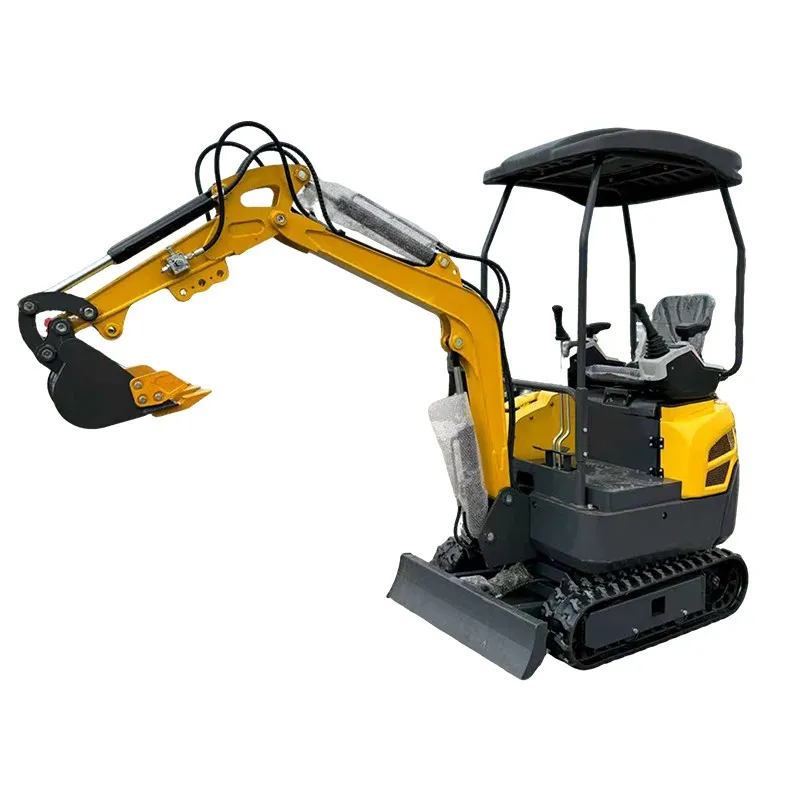
custom mini excavator
When most people hear 'custom mini excavator', they picture picking a color and maybe a bucket size from a catalog. That's the first mistake. Real customization isn't a menu; it's a conversation that starts with the job site's mud, the operator's habits, and the budget's hard ceiling. It's where the brochure ends and actual engineering begins.
The Custom Misconception and Ground Truth
Let's be clear: slapping on a longer dipper arm isn't true customization. I've seen buyers get fixated on lift capacity or digging depth, only to find the machine tips over on a slight slope because the counterweight was an afterthought. The core of a custom mini excavator is integration. It's about whether the auxiliary hydraulic circuit has enough flow and pressure for that specific breaker or mulcher you'll run 80% of the time, not just that it has the ports. You don't just add attachments; you build the machine around them.
I recall a landscape contractor who insisted on a zero-tail-swing model for tight urban backyards. Standard choice, right? But his main work was deep trenching for drainage. The standard stick on that zero-tail model created a terrible digging envelope for deep, vertical walls. The custom solution wasn't more power; it was a geometrically optimized stick and boom assembly. We lengthened the stick, tweaked the boom angles, and recalibrated the hydraulic flow curves for smoother, more precise control at depth. The factory specs looked worse on paper for reach over height, but on his site, productivity jumped 30% because the machine finally fit the task.
This is where companies that just assemble parts fail. You need a partner with design and fabrication in-house. I've worked with Shandong Pioneer Engineering Machinery Co., Ltd on a few projects, and their setup is telling. They have their own manufacturing arm, Shandong Hexin. When you discuss a modification, their engineers can walk directly onto the production area floor and prototype. That's crucial. It means feedback loops are measured in hours, not weeks of emailing a third-party supplier. Their relocation to a larger facility in Ningyang in 2023 seems to have been driven by this need for integrated, flexible production space, not just more assembly lines.
Hydraulics: The Heart of the Matter
If the engine is the heart, the hydraulics are the nervous system. This is where customization gets technical and where most generic machines show their limits. A common request is for a high-flow circuit for a forestry mulcher. The easy route is to install a bigger pump. But that steals power from the main circuits, making swing and travel sluggish. The real fix involves a dedicated, priority-based valve block and sometimes even tweaking the engine's torque curve to deliver power where it's needed, when it's needed.
I learned this the hard way early on. We modified a 3.5-ton machine for a rental fleet, adding a thumb and a planer. We upgraded the pump, but didn't address the valve spool logic. The result? When the operator used the thumb and tried to swing simultaneously, the machine would literally stall. It was a classic case of treating symptoms, not the system. The solution was a custom valve stack that prioritized the swing function when multiple functions were engaged, a fix that required deep hydraulic system knowledge.
Looking at the projects from a manufacturer like Pioneer, their experience exporting to markets like Germany and Australia is key. Operators there are demanding and regulations strict. To meet that, their engineering has to handle complex hydraulic integration requests reliably. It's not about being the cheapest; it's about the system's coherence. A custom mini excavator with poorly integrated hydraulics will overheat, wear out seals in months, and become a money pit.
Structural Integrity: The Forgotten Factor
Adding a heavier counterweight or a demolition hammer stresses the machine in ways the original design might not account for. I've seen cracked mainframes on customized machines where the reinforcement was just a welded-on plate, not a redesigned casting or a properly gusseted structure. The stress points move. You can't just reinforce where it's cracking now; you need to analyze where the new loads will travel and strengthen that entire path.
A concrete example: a client in Canada needed a machine for frozen ground work with a heavy-duty breaker. The standard undercarriage and mainframe on his chosen model were fine for digging, but the constant, high-impact shocks from the breaker were transmitting massive shock loads through the boom footings and into the swing bearing. The customization involved not just a heavier-duty mount for the breaker, but also localized hardening of the boom casting, upgrading the swing bearing specification, and adding tuned vibration-damping material in the cab mounts. The custom mini excavator became a different, tougher animal.
This is where a manufacturer's longevity matters. A company like Shandong Pioneer, with nearly two decades of development, has likely seen these failure modes. Their 20 years of development and accumulation isn't just a marketing line; it's a library of past stress tests, client feedback, and iterative design improvements. When they suggest a specific reinforcement pattern for a custom application, it's probably because they've seen what happens without it.
The Economics of Customization
It's never the cheapest option upfront. The break-even point is the critical calculation. For a single machine doing unique, high-value work (like interior demolition or specialized landscaping), customization pays for itself in months through sheer efficiency and capability. For a fleet owner, it's trickier. You might standardize on a custom feature—like a unified quick-coupler system or enhanced cab filtration for dusty sites—across multiple units to gain operational simplicity and lower long-term maintenance.
One failed experiment was with a client who wanted to customize every machine in a 10-unit fleet differently for slightly different niches. It was a logistics and maintenance nightmare. Inventory for filters, hoses, and parts ballooned. The successful approach was the opposite: we worked with the manufacturer to design a highly adaptable base platform. Common chassis, common hydraulics, but with pre-engineered, bolt-on kits for different applications (e.g., a landscaping kit with wider tracks, a grading blade, and a high-flow circuit; a demolition kit with a reinforced cab, hydraulic dust suppression, and a heavier counterweight). This is the sweet spot for scalable customization.
This modular approach is what allows a supplier to serve diverse markets from the United States to Australia effectively. It's not about building a thousand unique machines; it's about building one intelligent platform a thousand different ways. Visiting a site like https://www.sdpioneer.com, you can often gauge this capability not by the flashy pictures, but by the depth of technical documentation and the range of compatible attachments and options listed—it hints at a platform designed for variation.
The Human Element: Operator Interface
This is the most overlooked part. You can have the perfect machine mechanically, but if the controls are unintuitive for the new function, you've lost. Customization must extend to the operator's station. For a machine fitted with a tiltrotator or a complex grapple, we often remap the auxiliary controls from simple foot pedals to proportional joystick buttons. Sometimes, we even adjust the control pattern (ISO to SAE or vice-versa) based on the operator's muscle memory.
A lesson from a vineyard installation project: the machine was fitted with a narrow, laser-guided trenching attachment. The standard joystick was too coarse for the precision needed. The customization included installing a miniature, fingertip-controlled joystick on the main lever for micro-adjustments of the attachment. It cost extra, but it turned a frustrating, slow job into a smooth one. The operator's fatigue dropped significantly. That's a successful custom job—it considers the human in the seat.
Manufacturers that understand overseas trade get this. An operator in Germany has different expectations for ergonomics and control feedback than one in another region. A company that merely exports a one-size-fits-all cabin will hit a ceiling. The ability to customize control schemes, seat types, and even display language and units (metric/imperial) at the factory level is a sign of a mature, client-focused provider. It's these subtle, human-centric details that often win the trust and appreciation of customers worldwide, more than raw power numbers.
So, the next time you think about a custom mini excavator, start with the problem, not the product. Talk about the sticky clay, the low-hanging wires, the operator's sore back at the end of the day. Then find a partner who listens and has the technical depth to translate those site problems into steel, hydraulics, and software. That's the difference between a modified machine and a truly custom solution. The rest is just parts.
Related Products
Related Products