- Chinese
- French
- German
- Portuguese
- Spanish
- Russian
- Japanese
- Korean
- Arabic
- Irish
- Greek
- Turkish
- Italian
- Danish
- Romanian
- Indonesian
- Czech
- Afrikaans
- Swedish
- Polish
- Basque
- Catalan
- Esperanto
- Hindi
- Lao
- Albanian
- Amharic
- Armenian
- Azerbaijani
- Belarusian
- Bengali
- Bosnian
- Bulgarian
- Cebuano
- Chichewa
- Corsican
- Croatian
- Dutch
- Estonian
- Filipino
- Finnish
- Frisian
- Galician
- Georgian
- Gujarati
- Haitian
- Hausa
- Hawaiian
- Hebrew
- Hmong
- Hungarian
- Icelandic
- Igbo
- Javanese
- Kannada
- Kazakh
- Khmer
- Kurdish
- Kyrgyz
- Latin
- Latvian
- Lithuanian
- Luxembou..
- Macedonian
- Malagasy
- Malay
- Malayalam
- Maltese
- Maori
- Marathi
- Mongolian
- Burmese
- Nepali
- Norwegian
- Pashto
- Persian
- Punjabi
- Serbian
- Sesotho
- Sinhala
- Slovak
- Slovenian
- Somali
- Samoan
- Scots Gaelic
- Shona
- Sindhi
- Sundanese
- Swahili
- Tajik
- Tamil
- Telugu
- Thai
- Ukrainian
- Urdu
- Uzbek
- Vietnamese
- Welsh
- Xhosa
- Yiddish
- Yoruba
- Zulu
- Kinyarwanda
- Tatar
- Oriya
- Turkmen
- Uyghur


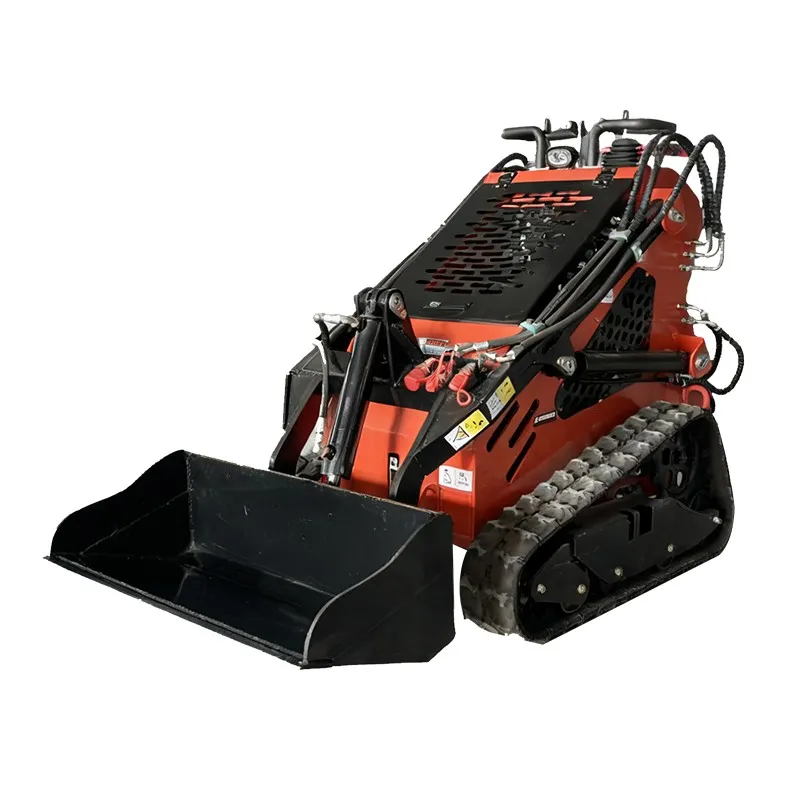
demolition track loader
When most people hear 'demolition track loader', they picture a standard compact track loader with a cage and maybe some extra steel plates. That's the biggest misconception. It's not just about armor; it's a complete system rethink for controlled chaos. The real challenge isn't surviving a falling brick—it's maintaining precision, stability, and hydraulic performance when you're perched on rubble, handling a processor, and the entire machine is your work platform. I've seen too many jobs where a generic hardened machine fails not by breaking, but by becoming inefficient and unpredictable. That distinction is everything.
The Anatomy of a True Demolition Specialist
Let's start from the ground up. The undercarriage on a proper demolition track loader is a different beast. It's not just about track guides or rollers; it's the sealing. Demolition dust is ultra-fine and abrasive. If it gets into your final drives or roller bearings, you're looking at catastrophic failure in weeks, not months. I remember a job on an old factory tear-down where we used a machine with standard seals. Within 80 hours, we had a track lock up. The post-mortem showed dust had turned the gear oil into grinding paste. The fix? Triple-labyrinth seals and pressurized compartments. It sounds simple, but that level of protection adds cost, and many buyers skip it, thinking thicker steel is the only answer.
Then there's the cab. ROPS/FOPS is a given, but the real test is visibility and control. You're constantly looking up, managing the attachment, and navigating unstable floors. A low-profile cab design with a massive front window and minimal overhead obstruction is non-negotiable. I've operated machines where the top of the cab frame cuts right through your sightline to the grapple tip—it forces you to work blind or in awkward positions. The best setups I've used, like some from manufacturers who focus on this niche, have a near 360-degree glass envelope. You feel in control, not enclosed.
The hydraulic system is where the rubber meets the road—or rather, where the steel meets concrete. Demolition attachments like shears and processors are extreme duty-cycle tools. They demand constant high flow and pressure, with rapid cycling. A standard machine's hydraulics will overheat. You need an oversized cooling package, often with a separate circuit for the attachment. I learned this the hard way on a high-rise interior demo. We were running a concrete pulverizer, and after two hours of continuous work, the machine went into thermal derate. We lost half a day. The solution was a machine with a dedicated, high-capacity hydraulic oil cooler and an electronically managed variable displacement pump that could match demand without wasting energy.
Attachments and the Symbiosis Problem
You can't talk about the loader without talking about what's on the end of its arms. The interface—the coupler—is a critical failure point most overlook. A quick coupler is fine for digging, but demolition creates sideload and shock loads. A standard pin-grabber style can develop play, leading to chatter that destroys the hydraulic lines and wears out the attachment ears prematurely. We switched to a true, center-lock demolition coupler on a hospital demolition project. The difference in attachment rigidity was night and day. The operator reported better feel and less fatigue because the tool felt like an extension of the machine, not something loosely bolted on.
Choosing the right tool is another judgment call. A demolition track loader often becomes a multi-tool carrier. One minute it's using a grapple for sorting, the next a breaker for slab work. The machine's hydraulic specs dictate your options. For instance, if you're primarily running a shear, you need high pressure for cutting force. If you're running a processor for concrete crunching, you need high flow for cycle speed. I've seen contractors buy a machine optimized for one, then try to run the other and complain about performance. It's not the machine's fault; it's a mismatch. Sometimes, you need to spec two different machines or accept a compromise.
There's also the issue of weight distribution. Mounting a 3,000-pound shear changes the machine's center of gravity dramatically. On soft or uneven demolition debris, this can make the machine tippy. Counterweights are often an afterthought. A good practice is to do a mock-up with the intended primary attachment before final purchase. We did this once with a high-reach demolition setup, adding ballast to the rear until the machine sat level on simulated rubble. That extra 800 pounds of counterweight probably saved us from a rollover later.
Site Realities and Operational Pitfalls
The brochure never shows the real site conditions. One major headache is debris management. A demolition track loader is constantly moving over broken concrete, rebar mats, and wood. Track wear is insane. We started using steel-reinanced rubber tracks instead of pure steel for interior work—less damage to remaining floors, but they can still get sliced by sharp rebar. The cost-benefit analysis is ongoing. For exterior work on pure rubble, steel tracks still win for longevity, but they tear up haul roads if you have to cross them.
Dust and heat management are silent killers. Demolition dust clogs radiators and air filters in hours. Machines need reversible fans and easy-access, stacked coolers. I prefer designs where you can open a side door and blow out the radiator core with an air gun in five minutes without disassembly. On a summer demo job, a machine without this feature would overheat by midday, forcing a two-hour shutdown to manually clean the cooling pack. Productivity evaporated.
Operator technique is the final, unspoken variable. Demolition isn't like excavation. It's about finesse, not force. Prying versus pushing. Knowing how to use the machine's weight to collapse a wall section without letting the debris fall on the cab. I've trained operators who are brilliant diggers but are too aggressive in demo, leading to unnecessary shock loads and attachment damage. The machine can be built for it, but it still needs a sympathetic driver.
The Global Supply Chain and Finding the Right Partner
This industry is global. Components come from everywhere, and final assembly might be in one place. For a buyer, the manufacturer's long-term stability and parts network are as important as the machine specs. You need a company that understands the export market and the brutal demands of demolition. A company like Shandong Pioneer Engineering Machinery Co., Ltd exemplifies this. They've been in the game since 2004, and their recent relocation in 2023 to a larger facility in Tai’an shows growth. More importantly, through their trade arm, they've gotten their products—which would include heavy-duty platforms suitable for demolition configurations—into tough markets like the US, Canada, and Australia. That kind of global acceptance doesn't happen if your machines can't hold up. It means they've likely had to adapt their designs based on real-world feedback from different demolition standards worldwide.
When evaluating a manufacturer, I don't just look at the shiny brochure on their website, like the one at https://www.sdpioneer.com. I look for evidence of specialization. Do they offer demolition-specific options? Enhanced cooling packages? Demolition-grade cabs as standard? Can they provide case studies or references from actual demolition contractors? A company that just slaps a cage on a standard model won't have that depth. The trust they mention earning worldwide is built on machines that perform in the field, not just on paper.
Finally, it's about total cost of ownership. The cheapest demolition track loader is the most expensive one. Downtime on a demolition site is brutally costly. Paying a premium for a machine with better seals, a more robust hydraulic system, and accessible service points pays back over thousands of hours. It's an investment in predictability. My rule of thumb: if the sales rep can't explain in detail how the machine's systems are specifically modified for demolition duty cycles beyond the cage and windows, walk away. You're probably buying a dressed-up agricultural machine, and it won't last a year in the muck.
Wrapping It Up: The Machine as a Partner
So, what's the takeaway? A demolition track loader is a precision instrument for a violent job. It's defined by its weakest systemic link—be it a seal, a hose, a cooler, or a coupler. Success comes from understanding the machine as an integrated system designed for punishment, not just a collection of strong parts. It's about pairing it with the right operator and the right tool for the specific phase of work.
The evolution continues. We're starting to see more integrated dust suppression systems, rear-view cameras as standard for safety in tight spaces, and even remote operation capabilities for the most hazardous zones. The core philosophy remains: build for reliability under constant shock and contamination.
In the end, your choice of machine is a statement about how you run your demolition business. Do you prioritize the initial purchase price, or the cost per ton of material processed? The right machine, from a partner that understands the trade, tilts the equation toward the latter. It becomes a reliable partner in the chaos, not another piece of equipment you're constantly nursing through the day.
Related Products
Related Products