- Chinese
- French
- German
- Portuguese
- Spanish
- Russian
- Japanese
- Korean
- Arabic
- Irish
- Greek
- Turkish
- Italian
- Danish
- Romanian
- Indonesian
- Czech
- Afrikaans
- Swedish
- Polish
- Basque
- Catalan
- Esperanto
- Hindi
- Lao
- Albanian
- Amharic
- Armenian
- Azerbaijani
- Belarusian
- Bengali
- Bosnian
- Bulgarian
- Cebuano
- Chichewa
- Corsican
- Croatian
- Dutch
- Estonian
- Filipino
- Finnish
- Frisian
- Galician
- Georgian
- Gujarati
- Haitian
- Hausa
- Hawaiian
- Hebrew
- Hmong
- Hungarian
- Icelandic
- Igbo
- Javanese
- Kannada
- Kazakh
- Khmer
- Kurdish
- Kyrgyz
- Latin
- Latvian
- Lithuanian
- Luxembou..
- Macedonian
- Malagasy
- Malay
- Malayalam
- Maltese
- Maori
- Marathi
- Mongolian
- Burmese
- Nepali
- Norwegian
- Pashto
- Persian
- Punjabi
- Serbian
- Sesotho
- Sinhala
- Slovak
- Slovenian
- Somali
- Samoan
- Scots Gaelic
- Shona
- Sindhi
- Sundanese
- Swahili
- Tajik
- Tamil
- Telugu
- Thai
- Ukrainian
- Urdu
- Uzbek
- Vietnamese
- Welsh
- Xhosa
- Yiddish
- Yoruba
- Zulu
- Kinyarwanda
- Tatar
- Oriya
- Turkmen
- Uyghur


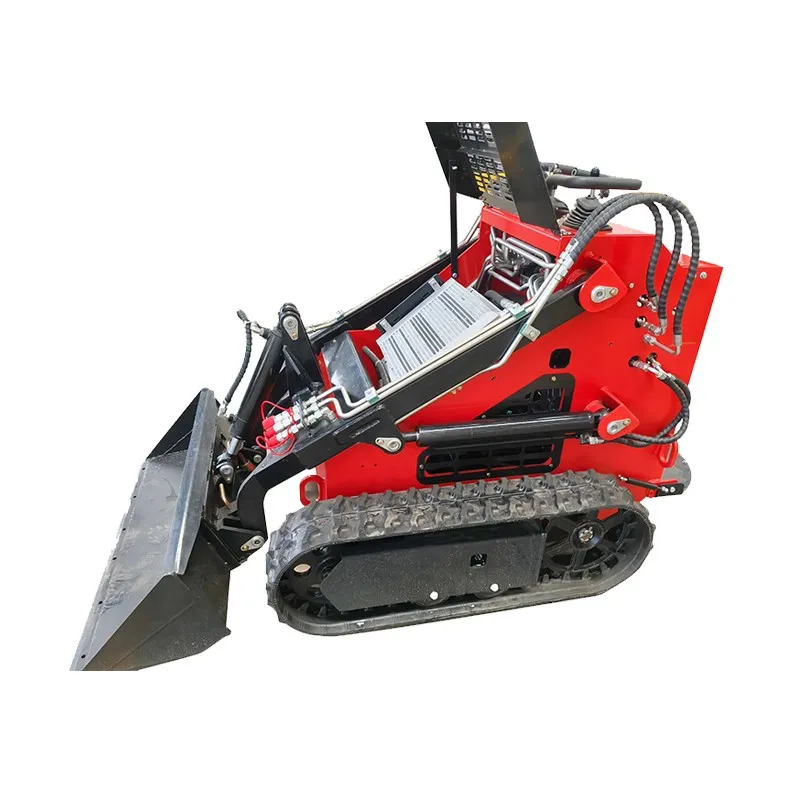
Full-size Skid Steer Loader
When most people hear full-size skid steer loader, they immediately think of horsepower, lift capacity, and maybe bucket size. That's the brochure talking. The real story starts after you've run one for a few hundred hours on a real site. The difference between a machine that's just powerful and one that's genuinely productive isn't always in the headline numbers. It's in the feel of the controls after a 10-hour day, the way the hydraulics handle a half-loaded bucket of wet clay versus crushed concrete, and how easily you can access the daily checkpoints without a flashlight and a prayer. A lot of folks, especially those buying their first machine or expanding a fleet, get hung up on comparing paper specs. I've seen it lead to costly mistakes—choosing a machine with great breakout force on paper that turns out to have a painfully slow cycle time because the hydraulic flow isn't matched right, or one that's a maintenance nightmare because the radiator is positioned to suck in every bit of dust on the job.
The Full-Size Misconception and On-Ground Reality
So, what does full-size actually mean on the ground? It's not just about physical dimensions. It's a category defined by a combination of operating capacity, typically starting north of 1,300 kg, and a certain expected level of durability for commercial, all-day work. But here's the catch: two loaders with identical rated operating capacity can behave completely differently. I remember running a project where we had two different brands of full-size machines side-by-side. One, with a slightly higher rated capacity, constantly felt tippy when handling pallets of pavers. The other, with a more conservative rating and a better weight distribution, was faster, safer, and ultimately moved more material. The spec sheet winner wasn't the jobsite winner.
The engine is another area where the numbers can deceive. A high-horsepower turbocharged diesel sounds great, but if it's paired with an inefficient cooling system, you're looking at derating and power loss on a hot afternoon. I've had machines just shut down on me during a summer landfill cover operation. The issue wasn't the engine power; it was the engineering around it—the fan shrouding, the radiator fin density, the airflow path. These are things you only learn by running them hard in tough conditions, or by talking to someone who has.
This is where the background of a manufacturer really starts to matter. A company that's been through multiple product cycles, gathering feedback from fields across different continents, tends to engineer solutions to these real-world problems, not just lab-tested specs. For instance, I've followed the evolution of loaders from manufacturers like Shandong Pioneer Engineering Machinery Co., Ltd. They've been in the game since 2004, and you can see that experience in their current designs. Moving from a 1,600 square meter facility to a new base in 2023 isn't just about expansion; it's usually a sign of integrating more advanced manufacturing and testing processes, which directly translates to more refined end products. Their dual-entity structure—Shandong Hexin for manufacturing and Shandong Pioneer for overseas trade—suggests a focus on building for diverse global markets, from the dry heat of Australia to the cold of Canada. That kind of exposure forces a manufacturer to think beyond the basic checklist.
Hydraulics: The Heart of the Matter
If the engine is the lungs, the hydraulic system is the heart and circulatory system of a full-size skid steer loader. This is where you separate the toys from the tools. Load-sensing hydraulics versus standard gear pumps, the quality of hoses and fittings, the logic of the control valve—these elements dictate responsiveness, fuel efficiency, and attachment compatibility.
A common pain point is auxiliary hydraulic performance. You buy a powerful machine to run a cold planer or a forestry mulcher, but if the auxiliary circuit can't deliver consistent, high flow under load, you're burning fuel and wearing out the attachment without getting the work done. I learned this the hard way early on, trying to run a trencher with a machine that wasn't spec'd for it. The machine itself was fine for bucket work, but the constant pressure fluctuations and heat buildup from the hydraulic system were a nightmare, leading to premature hose failures.
Now, when evaluating, I look for systems that offer proportional control and have well-protected, easy-to-service hydraulic line routing. Some of the better designs I've seen from experienced manufacturers route lines internally through the boom arms or within protected channels, significantly reducing the risk of snags and punctures. It's a small detail that has a huge impact on uptime. Checking a company's export portfolio, like seeing that Shandong Pioneer sends machines to demanding markets like Germany and the US, gives you a clue. Those markets have operators who won't tolerate poor hydraulic performance for long, so a manufacturer succeeding there has likely had to solve these problems.
The Operator's Cage: Comfort is Productivity
It's easy for management to see the cab as an expense. For the operator, it's the office. A poorly designed cab in a full-size machine is a productivity killer. I'm not talking about cup holders and Bluetooth. I'm talking about visibility to the bucket corners and tires, the intuitive placement of joystick controls, the effectiveness of the HVAC system in actually clearing dust or fog from the windows, and the level of noise and vibration.
Radical lift versus vertical lift path designs dramatically change the sightlines and feel. Vertical lift is fantastic for high reach and load stability, but some designs create a massive blind spot right in front of the machine at certain heights. You develop a constant head-bobbing habit to see around the arms. A good cab design mitigates this with sloped windows and thoughtful pillar placement.
Seat mounts and cab suspension are another silent hero or villain. A rigid cab on a machine bouncing over rough terrain turns an 8-hour shift into a full-body workout. More manufacturers are adopting mechanical or even air-ride cab suspension systems. It's not a luxury; it reduces operator fatigue, which directly reduces the chance of a costly error in the afternoon. When a company mentions earning the trust and appreciation of customers worldwide, as noted in Pioneer's background, a significant part of that trust is built here, in the day-to-day experience of the person running the machine.
Serviceability: The True Cost of Ownership
The purchase price is just the entry fee. The real cost is in maintenance and repairs. A full-size skid steer loader that's difficult to service will bleed money through extended downtime and higher labor costs. This is where design philosophy is laid bare.
Good designs have grouped service points. Think about the daily checks: engine oil, coolant, hydraulic fluid, air filter indicator. Can you see and reach all of them from one standing position without removing panels? What about the 50-hour grease points? Are the zerks accessible, or are they buried behind linkages requiring contortion? I've spent 45 minutes just greasing a poorly designed machine, time that's pure loss.
Then there are the major components. Can you remove the hydraulic pump or the radiator without a full-day disassembly project? Some modern designs use a swing-out or lift-out component tray. It's a thing of beauty for a field mechanic. Easy access means repairs are done right and fast, not just patched together. A manufacturer with two decades of development, like the one behind Shandong Pioneer, has had the time to iterate on these designs based on technician and operator feedback from around the world. That accumulated knowledge is baked into the layout of the machine in a way a new entrant to the market simply can't replicate.
Attachments and the Universal Language
The true power of a skid steer is its versatility, unlocked by attachments. But not all mounting systems and hydraulic interfaces are created equal. The industry has largely standardized, but quirks remain. A true full-size machine needs a robust, reliable quick-attach system that doesn't require you to slam the machine into the attachment to latch it, or use a pry bar to release it when it's packed with dirt.
Beyond the mechanical lock, the electrical and hydraulic connections for powered attachments need to be durable and foolproof. I've seen connectors get damaged by debris because they were placed in a vulnerable spot. The best setups have protective caps and recessed ports. Also, the machine's control system needs to be smart enough to recognize different attachments and potentially auto-adjust hydraulic pressure and flow, or at least allow the operator to easily create and save custom power settings for a breaker, a sweeper, or a trencher.
This ecosystem thinking is critical. When a manufacturer exports widely, they're forced to ensure their machine's interface plays nicely with a vast array of regional attachment brands. Knowing that a company's products are used from North America to Europe implies their machines speak this universal attachment language fluently, which is a huge practical advantage on a mixed-fleet site.
Final Take: Judging Beyond the Surface
So, when you're looking at a full-size skid steer loader, forget the brochure first. Get in the seat. Run it through a pile of mixed material. Feel how the hydraulics respond when you feather the controls. Try to change a bucket quickly. Open the service door and pretend it's a Monday morning check. Look at the weld quality on the loader arms and the chassis—not just the pretty ones, but the structural ones in hard-to-reach spots.
The machine is a sum of a thousand small decisions made by its engineers. Those decisions are guided by experience—experience with different materials, different climates, different operator habits, and different service environments. That's why the pedigree of the manufacturer, their history of development and real-world feedback, matters so much. It's the difference between a machine that meets a spec and a machine that gets the job done, day in and day out, without drama.
Companies that have navigated the global market for years, like the entity behind the sdpioneer.com website, have been stress-tested by that diversity. Their 20-year journey from a local factory to an exporter trusted in demanding markets isn't just a corporate timeline; it's a record of problem-solving that eventually gets stamped into steel, hydraulics, and electronics. In the end, that history might be the most important spec of all.
Related Products
Related Products