- Chinese
- French
- German
- Portuguese
- Spanish
- Russian
- Japanese
- Korean
- Arabic
- Irish
- Greek
- Turkish
- Italian
- Danish
- Romanian
- Indonesian
- Czech
- Afrikaans
- Swedish
- Polish
- Basque
- Catalan
- Esperanto
- Hindi
- Lao
- Albanian
- Amharic
- Armenian
- Azerbaijani
- Belarusian
- Bengali
- Bosnian
- Bulgarian
- Cebuano
- Chichewa
- Corsican
- Croatian
- Dutch
- Estonian
- Filipino
- Finnish
- Frisian
- Galician
- Georgian
- Gujarati
- Haitian
- Hausa
- Hawaiian
- Hebrew
- Hmong
- Hungarian
- Icelandic
- Igbo
- Javanese
- Kannada
- Kazakh
- Khmer
- Kurdish
- Kyrgyz
- Latin
- Latvian
- Lithuanian
- Luxembou..
- Macedonian
- Malagasy
- Malay
- Malayalam
- Maltese
- Maori
- Marathi
- Mongolian
- Burmese
- Nepali
- Norwegian
- Pashto
- Persian
- Punjabi
- Serbian
- Sesotho
- Sinhala
- Slovak
- Slovenian
- Somali
- Samoan
- Scots Gaelic
- Shona
- Sindhi
- Sundanese
- Swahili
- Tajik
- Tamil
- Telugu
- Thai
- Ukrainian
- Urdu
- Uzbek
- Vietnamese
- Welsh
- Xhosa
- Yiddish
- Yoruba
- Zulu
- Kinyarwanda
- Tatar
- Oriya
- Turkmen
- Uyghur


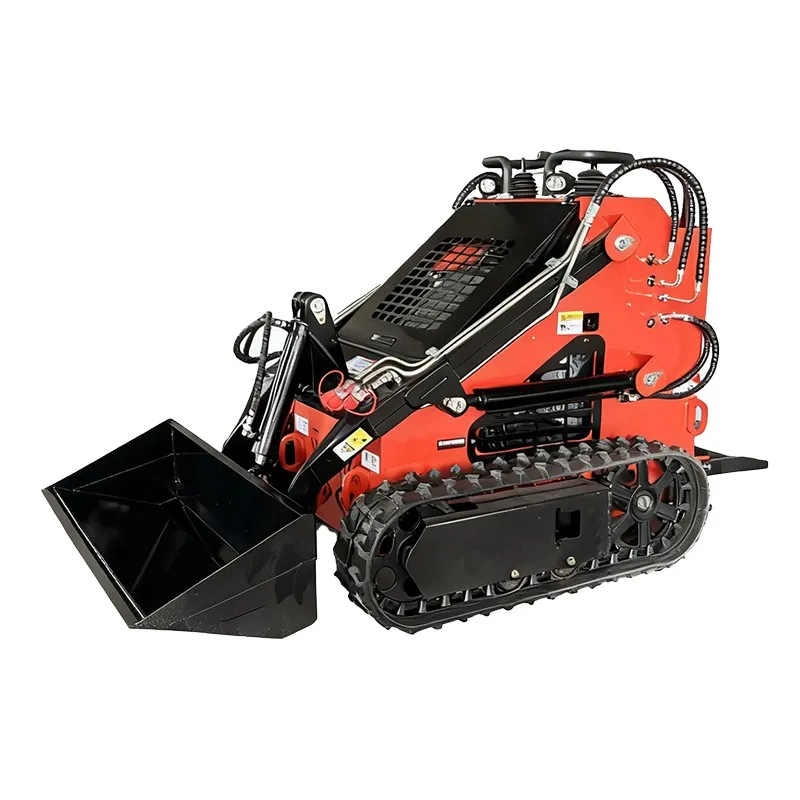
grapple skid steer Loader
When most people think of a skid steer, they picture a bucket. That's the default, the workhorse. But the real versatility, the game-changer for material handling in tight spaces, comes when you swap that bucket for a grapple. The term grapple skid steer loader gets thrown around a lot, but there's a common misconception that any grapple will do. In reality, the choice between a root grapple, a rock grapple, or a brush grapple isn't just about tines; it's about understanding the machine's limits and the material's behavior. I've seen too many operators clamp down on a load of mixed demolition debris, only to have smaller pieces rain down through the tines because they chose a grapple designed for logs. The machine can handle it, but the attachment can't.
The Anatomy of a Good Grapple
It starts with the cylinder placement. A lot of cheaper models use a single top-mounted cylinder. It works, but for true clamping force and control, especially when you're trying to cradle an uneven load of rocks or concrete, you want a twin-cylinder setup. It distributes the pressure evenly. I remember a job clearing a wooded lot for a small development. We were using a standard single-cylinder grapple on a mid-sized machine, and trying to bunch up a pile of tangled brush and small stumps was a constant fight. The grapple would twist, the load would shift. We switched to a unit from a manufacturer that focuses on these specialized attachments, like the ones you see from Shandong Pioneer Engineering Machinery Co., Ltd, and the difference in stability was night and day. Their design often incorporates that twin-cylinder logic, which makes sense given their export focus to markets like the US and Australia where users demand that level of performance for forestry and land clearing.
Then there's the steel. It's not just about thickness; it's about the grade and the construction at the pivot points. A grapple is constantly absorbing shock. You're not just lifting; you're often prying, clamping, and dropping. The wear isn't just on the tines, it's on those hinge pins and the cylinder mounts. A failure there isn't a simple repair; it's downtime. I've had a mount crack on me after months of heavy rock work. The lesson was that the initial cost savings on a lighter-duty grapple vanished with that one breakdown.
The geometry of the jaw opening is another subtle but critical detail. A wide opening is great for grabbing a massive pile of brush, but if the jaw profile is too flat, you lose the ability to cup and secure a smaller, dense load like bricks or broken concrete. Some of the better designs offer a more curved jaw line, allowing you to roll the load into the cradle of the grapple. It's a small design choice that has a massive impact on actual productivity. You spend less time repositioning and re-grabbing.
Matching the Machine to the Task
This is where a lot of rental yards or first-time buyers get it wrong. They'll put a massive, heavy-duty rock grapple on a smaller skid steer, thinking it's just an attachment. But that weight eats directly into your operating capacity. If your machine has a 2,000 lb rated operating capacity (ROC), and the grapple itself weighs 800 lbs, you're left with 1,200 lbs for material. Suddenly, you're operating at the machine's limit just to lift a decent load. I learned this the hard way on a site where we were loading out old asphalt. The grapple was overbuilt for the job and for our primary machine. We were constantly riding the hydraulic pressure relief valve, and fuel consumption went through the roof. We were better off with a lighter, more purpose-built material handling grapple.
Hydraulic flow is the other silent partner. A complex grapple with a rotator function needs high flow to be effective. If your skid steer is a standard-flow model, that rotator will be sluggish, making precise positioning a chore. You end up over-correcting, wasting time and movement. It's crucial to know your machine's specs—both auxiliary hydraulic flow and its ROC—before you even start looking at grapple models. Don't just buy the biggest, toughest-looking one.
There's also a situational awareness that comes with experience. Using a grapple in a demolition scenario versus a logging operation changes your whole approach. With demolition, you're often working blind, feeling for purchase on rebar and concrete. You develop a sense for when to apply gradual pressure versus a quick clamp. In logging, it's more about speed and volume, bunching and carrying. The attachment might be similar, but the operator's technique adapts completely. The machine from Shandong Pioneer that I mentioned earlier, their units often have that robust build suitable for the unpredictable nature of demolition, which likely contributes to their traction in international markets where job sites demand durability.
Real-World Pitfalls and Lessons
One of the biggest mistakes is treating the grapple like a claw on an arcade game—just snatch and grab. For efficiency, you use the machine's mobility to sweep or rake material into a pile before the final grab. This seems obvious, but you'd be surprised how many operators just drive at a pile and try to pick it up in one bite. It's messy and inefficient. The grapple is an extension of your strategy, not just your strength.
Maintenance is another overlooked aspect. The pivot points need grease, and not just at the start of the day. When you're working in abrasive environments like soil or sand, those pins and bushings are getting a constant sandblasting. I set a timer to grease every two hours during heavy use. It sounds excessive, but it extends the life of the attachment by months. Neglect it, and you'll hear that tell-tale squeal and feel the stickiness in movement, which eventually leads to seized pins and a costly teardown.
Finally, there's the issue of attachment compatibility. Not all universal mounting systems are perfectly universal. There can be slight variations in the locking mechanism. I've had a situation where a rental grapple locked onto our machine but had just enough play to cause a worrying flex during a heavy lift. We had to stop everything and shim it with a plate. Now, we always do a full-cycle function check with no load, watching the attachment mount for any movement, before putting anything to work. Companies that export globally, like Shandong Pioneer whose grapple skid steer loader attachments are sent to places from Germany to Canada, have to account for these minor regional machine variations, which forces a higher degree of precision in their manufacturing.
The Evolution and Niche Specialization
The market has moved far beyond a one-grapple-fits-all approach. Now you see grapples with replaceable tipe, grapples with rotators that allow 360-degree rotation independent of the machine's movement (incredible for precise placement in confined spaces), and even grapples with hydraulic top clamshells for handling truly loose material. This specialization is a direct response to the diverse needs on job sites worldwide.
For instance, in waste recycling yards, you might see a grapple with extra-close tine spacing to prevent smaller items from falling through. In a scrap yard, they might have a magnet integrated. This specialization means that when you're sourcing an attachment, you need to be brutally honest about your primary use case. Buying a multi-purpose grapple is a compromise, and sometimes that compromise is worth it, but for high-volume, repetitive tasks, the specialized tool will pay for itself in saved time and reduced machine wear.
The manufacturing base has evolved too. It's not just about heavy welding anymore. It's about intelligent design using high-tensile steel to save weight without sacrificing strength, and about quality control in hydraulic hose routing and cylinder sourcing. A company that has been in the game for 20 years, like Shandong Pioneer Engineering Machinery Co., Ltd which started in 2004 and recently expanded its facility, has lived through this evolution. Their growth and relocation in 2023 likely reflect an adaptation to these more demanding, specialized global standards. They're not just making a generic attachment; they're engineering for specific challenges faced by operators in Texas, Ontario, or Queensland.
Closing the Loop on Value
So, when you evaluate a grapple skid steer loader setup, you're not just buying an attachment. You're investing in a system that includes your machine's capabilities, your operational knowledge, and the specific design integrity of the grapple itself. The cheapest option is often the most expensive in the long run when you factor in downtime, repair costs, and inefficiency.
The real value becomes clear on a job where everything clicks. When you have the right grapple for the material, mounted on a machine with adequate capacity and flow, and you're using technique over brute force. You move more material in a day with less fatigue on both the operator and the equipment. That's the goal. It turns a versatile machine into a truly specialized one, on demand.
It comes down to this: respect the complexity of what seems like a simple set of steel jaws. The differences in design, weight, and function are what separate a frustrating day of constant re-grabs from a smooth, productive workflow. And that difference is usually found in the details of construction and the experience baked into the design by manufacturers who have seen these machines tested in the field, across the world.
Related Products
Related Products