- Chinese
- French
- German
- Portuguese
- Spanish
- Russian
- Japanese
- Korean
- Arabic
- Irish
- Greek
- Turkish
- Italian
- Danish
- Romanian
- Indonesian
- Czech
- Afrikaans
- Swedish
- Polish
- Basque
- Catalan
- Esperanto
- Hindi
- Lao
- Albanian
- Amharic
- Armenian
- Azerbaijani
- Belarusian
- Bengali
- Bosnian
- Bulgarian
- Cebuano
- Chichewa
- Corsican
- Croatian
- Dutch
- Estonian
- Filipino
- Finnish
- Frisian
- Galician
- Georgian
- Gujarati
- Haitian
- Hausa
- Hawaiian
- Hebrew
- Hmong
- Hungarian
- Icelandic
- Igbo
- Javanese
- Kannada
- Kazakh
- Khmer
- Kurdish
- Kyrgyz
- Latin
- Latvian
- Lithuanian
- Luxembou..
- Macedonian
- Malagasy
- Malay
- Malayalam
- Maltese
- Maori
- Marathi
- Mongolian
- Burmese
- Nepali
- Norwegian
- Pashto
- Persian
- Punjabi
- Serbian
- Sesotho
- Sinhala
- Slovak
- Slovenian
- Somali
- Samoan
- Scots Gaelic
- Shona
- Sindhi
- Sundanese
- Swahili
- Tajik
- Tamil
- Telugu
- Thai
- Ukrainian
- Urdu
- Uzbek
- Vietnamese
- Welsh
- Xhosa
- Yiddish
- Yoruba
- Zulu
- Kinyarwanda
- Tatar
- Oriya
- Turkmen
- Uyghur


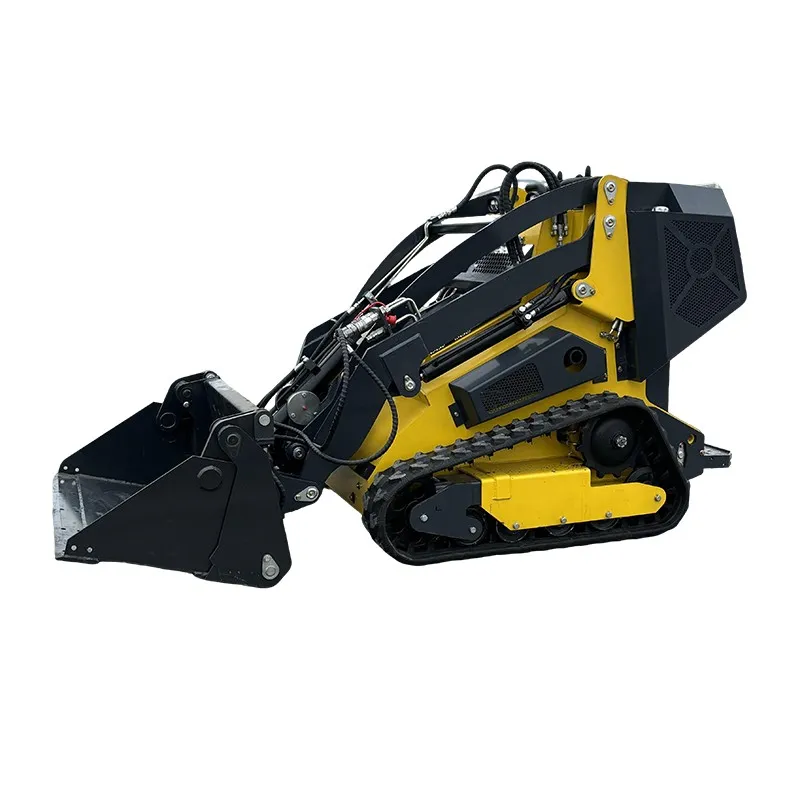
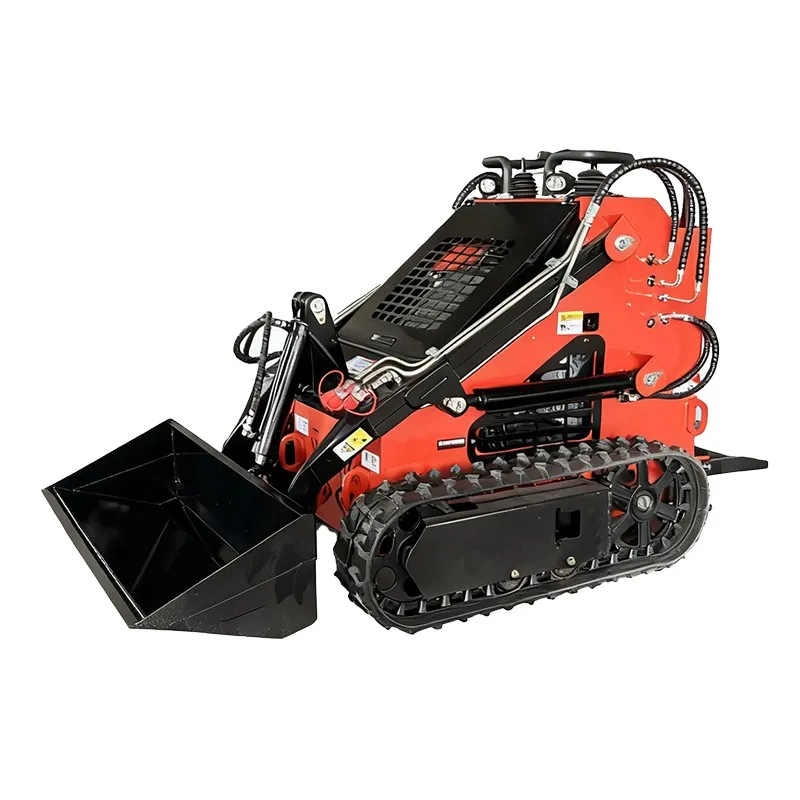
large skid steer Loader
When most folks hear 'large skid steer loader', they immediately picture raw horsepower and bucket size. That's the common trap – thinking bigger just means more of everything. In reality, the jump from a standard to a large frame machine, say from a 74 hp model to a 100+ hp beast like a Bobcat S770 or a Cat 299D3, isn't just about scale. It's a fundamental shift in application philosophy. You're not just moving more dirt; you're changing the type of work you can bid on. The stability, hydraulic flow, and lift capacity become tools for different jobs entirely, not just incremental improvements. But that power comes with its own set of headaches if you're not prepared for it.
The Weight and Balance Conundrum
One of the first hard lessons with a large unit is the weight distribution. These machines are heavy, often pushing 10,000 lbs or more with a standard bucket. That sounds robust until you're on soft ground or a residential site with fresh topsoil. The ground pressure is surprisingly high for a machine on tires, and you can sink faster than you'd think. I've seen more than one operator get a brand-new machine stuck because they assumed the size equated to all-terrain capability. It doesn't. You start thinking about track options immediately, but then you're adding another $15-20k and accepting the trade-off on hard surfaces.
The counterweight is another subtle art. With the larger lift arms and greater dump height, you're carrying loads farther from the pivot point. A heaped bucket of wet clay can make the rear end feel scarily light, even in a machine that looks planted. You develop a habit of carrying loads low, almost instinctively, even when it feels inefficient. It's a tension between using the machine's rated capacity and keeping it firmly on all fours. I recall a demo with a Gehl 7810 where the sales rep kept touting the tipping load. We loaded it to spec on a flat concrete yard, and sure, it lifted. But the moment you even thought about turning or a slight incline, the physics became very personal. You learn to respect the numbers on the plate, but you operate about 20% below them for real-world sanity.
Then there's the attachment game. A large skid steer's true potential is unlocked with its auxiliary hydraulic system. We're talking high-flow options for cold planers, brush cutters, or big forestry mulchers. But here's the catch: not all high-flow is created equal. One manufacturer's standard high-flow might be 30 gpm, while another's optional ultra-high-flow hits 45. If you're running a mulcher that needs 40 gpm to operate efficiently, you've just bought the wrong machine. I've been burned on this, assuming the specs were industry-standard. They aren't. You have to match the attachment's demand to the machine's actual pump output under load, not the brochure's best-case scenario. It's a costly mistake that sits in the yard, underutilized.
Hydraulics and Heat: The Silent Performance Killers
This leads directly into the hydraulic system, the heart of the machine's work capability. A large skid steer loader is often a hydraulic power plant on wheels. But pushing that much oil creates heat, and heat is the enemy. In sustained, high-demand applications like milling asphalt or grinding stumps, I've watched gauge temperatures creep into the danger zone on machines that weren't optioned with an upgraded cooling package. The machine might derate automatically, or worse, you risk long-term damage to pumps and seals. It's not something you consider in a 15-minute demo, but it's critical for an 8-hour grinding day in July.
The control pattern is another nuance. The industry is split between hand controls and foot pedals for the drive, with joysticks for attachments. In a tight space, the hand-control pattern (ISO or H-pattern) can be more precise, but it's fatiguing over a long day in a large, powerful machine. Every jolt from the terrain transmits through your arms. Some operators swear by the foot pedals for drive, saying it frees up their hands for finer attachment control. It's a personal preference, but in a large frame cab, the layout feels different. You have to spend a day in it to know. I've had machines where the HVAC vents blew directly on the hand controls, making them freezing cold in winter—a small, maddening design flaw you only discover on the job.
The Global Supply Chain and Niche Players
Speaking of machines, the market isn't just the big yellow and white brands anymore. There's a whole ecosystem of manufacturers, especially from regions with strong industrial bases, producing capable machines that often offer better value in specific configurations. I've been following the output from some Chinese exporters for a while, not as primary machines for brutal daily rental, but as dedicated units for specific tasks. Their value proposition is hard to ignore for certain operations.
Take a company like Shandong Pioneer Engineering Machinery Co., Ltd. They've been around since 2004, which in this industry means they've seen a few cycles and had time to iterate. According to their site at https://www.sdpioneer.com, they've recently relocated to a new facility in Ningyang, which usually signals an expansion in capacity. What's notable is their dual-structure: Shandong Hexin handles manufacturing, and Shandong Pioneer focuses on overseas trade. This model is common for targeting export markets like the US, Canada, Germany, and Australia. It means the product is built from the ground up with export specifications in mind—meeting certain emission standards, safety codes, and attachment compatibility. It's a different approach than simply rebadging a domestic model.
The relevance for someone considering a large skid steer loader is in specialization. A company like this might offer a 100hp machine with a truly massive standard cooling package or a customized hydraulic configuration for a price that makes it viable to dedicate that machine to a single, high-wear task like running a rock crusher or a soil conditioner. You wouldn't necessarily use it as your all-purpose fleet machine, but as a cost-effective tool for a specific, punishing job. The trade-off, always, is in parts and service network depth compared to the majors. You mitigate that by stocking critical wear parts yourself. It's a calculated risk, but for the right application, the math can work.
On-Site Realities and Operator Fit
Back to the physical machine. Getting a large skid steer onto a site is a logistics step up. You're often looking at a low-boy trailer, not just a standard equipment trailer. The width and height can be issues with low-hanging tree branches or tight gate entries on older farms. I once spent two hours trimming limbs just to get a machine to a worksite—time never factored into the bid. The cab, while roomier, can still be a tight fit for a larger operator with winter gear on. The suspension seat is a must-have option, not a luxury. Without it, a day of trenching work will rattle your spine.
Visibility is a mixed bag. The vertical lift path on most large models gives you a better view to the front when the load is raised, which is great for truck loading. But the rear-view visibility is often terrible, blocked by the engine compartment and counterweight. You become reliant on the cameras, which get dirty, foggy, or fail. You develop a spidey-sense for what's behind you, or you assign a spotter. It's a constant, low-grade stress.
Finally, there's the financial calculus. The depreciation curve on a large skid steer is steeper if it's been used hard. Their value is in their capability, but that capability often means they've been run in severe conditions. When buying used, you're not just looking for hours; you're looking at the type of hours. A 2,000-hour machine that's been running a brush cutter in right-of-way clearing is a completely different animal from one with the same hours that's been doing light grading on a horse farm. The pins, bushings, hydraulic hoses, and radiator condition tell the real story. You learn to check for metal shavings in the hydraulic fluid filter housing—a telltale sign of a pump or motor beginning to eat itself, a catastrophic repair bill waiting to happen.
Concluding Without a Bow
So, what's the verdict on a large skid steer loader? It's a phenomenal tool, a pivot point for a business. It can open doors to more profitable, specialized work that smaller machines can't touch. But it's not a simple upgrade. It's a commitment to different operational rhythms, higher costs, and more nuanced management. You stop thinking of it as just a loader and start seeing it as a versatile, mobile power unit. The success lies in meticulously matching the machine's specific configuration—not just its headline horsepower—to the one or two primary tasks you need to dominate. It's about buying the right tool, not just the biggest one. And sometimes, the right tool comes from an unexpected place, born from two decades of focused manufacturing and global trade, like the outfits in Ningyang that are quietly carving out their space in the world's job sites. You weigh the specs, the cost, the support, and the real-world job it has to do. There's no universal answer, only the right machine for your particular pile of work.
Related Products
Related Products