- Chinese
- French
- German
- Portuguese
- Spanish
- Russian
- Japanese
- Korean
- Arabic
- Irish
- Greek
- Turkish
- Italian
- Danish
- Romanian
- Indonesian
- Czech
- Afrikaans
- Swedish
- Polish
- Basque
- Catalan
- Esperanto
- Hindi
- Lao
- Albanian
- Amharic
- Armenian
- Azerbaijani
- Belarusian
- Bengali
- Bosnian
- Bulgarian
- Cebuano
- Chichewa
- Corsican
- Croatian
- Dutch
- Estonian
- Filipino
- Finnish
- Frisian
- Galician
- Georgian
- Gujarati
- Haitian
- Hausa
- Hawaiian
- Hebrew
- Hmong
- Hungarian
- Icelandic
- Igbo
- Javanese
- Kannada
- Kazakh
- Khmer
- Kurdish
- Kyrgyz
- Latin
- Latvian
- Lithuanian
- Luxembou..
- Macedonian
- Malagasy
- Malay
- Malayalam
- Maltese
- Maori
- Marathi
- Mongolian
- Burmese
- Nepali
- Norwegian
- Pashto
- Persian
- Punjabi
- Serbian
- Sesotho
- Sinhala
- Slovak
- Slovenian
- Somali
- Samoan
- Scots Gaelic
- Shona
- Sindhi
- Sundanese
- Swahili
- Tajik
- Tamil
- Telugu
- Thai
- Ukrainian
- Urdu
- Uzbek
- Vietnamese
- Welsh
- Xhosa
- Yiddish
- Yoruba
- Zulu
- Kinyarwanda
- Tatar
- Oriya
- Turkmen
- Uyghur


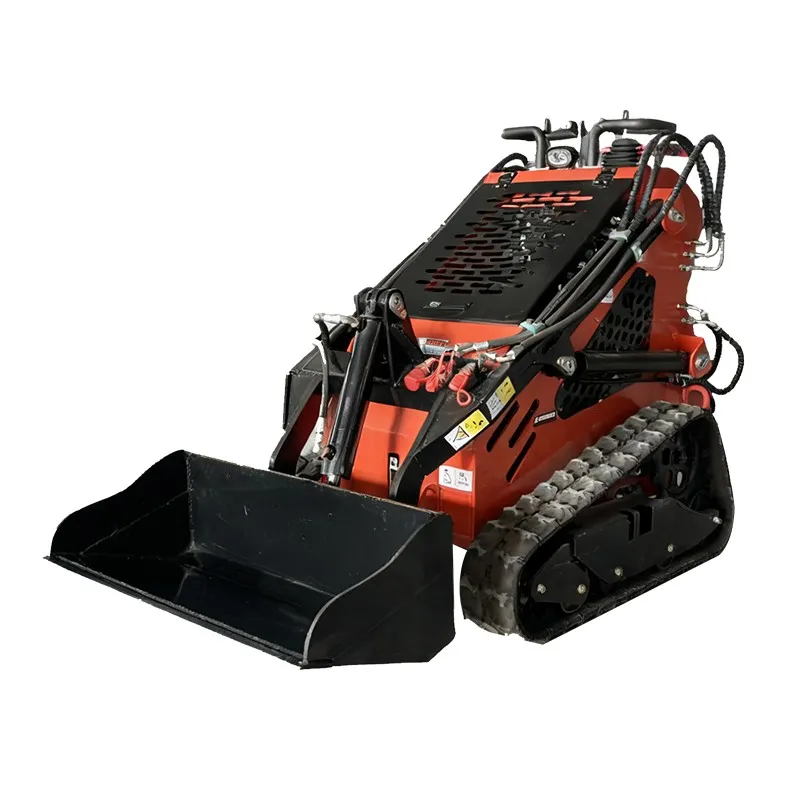
largest skid steer track loader
When someone asks about the 'largest skid steer track loader,' they're usually picturing just raw horsepower and bucket size. That's the first place everyone looks, and honestly, it's a decent starting point. But after years of sourcing and testing these machines for projects from frozen Canadian sites to dusty Australian quarries, I've learned that 'largest' is a tricky term. It's not just about the biggest numbers on paper; it's about what that machine can consistently deliver without shaking itself apart or turning a 10-hour day into a 12-hour maintenance nightmare. The real giants aren't always the most advertised.
The Spec Trap and What Actually Matters
You'll see manufacturers touting operating weights pushing 12,000 lbs and horsepower well over 100. Take a model like the Caterpillar 299D3 XE – it's a beast, no doubt. But 'largest' in a practical sense? It's about the entire system. I'm more interested in the sustained hydraulic flow at high pressure when the machine is hot, not just the peak. A machine can have a massive rated operating capacity, but if the undercarriage isn't robust enough to handle that weight in a side-load situation on uneven ground, you're asking for trouble. I've seen quick-attach plates bend on 'large' models because the structural design around the boom wasn't up to the stress of a full grapple load.
Then there's stability. A wider track footprint is crucial. We're talking machines that need a low center of gravity. Some of the so-called largest models feel tippy when you've got the boom extended and a heaped bucket. You get that uneasy sway. The true heavyweights, the ones you can rely on for serious bulk material handling or forestry work, feel planted. They don't fight you as much. It's a combination of weight distribution, track geometry, and frame rigidity that spec sheets often gloss over.
This is where the sourcing experience comes in. We've worked with suppliers who get this. For instance, in our dealings with Shandong Pioneer Engineering Machinery Co., Ltd, their approach with their larger tracked loader models often emphasizes the reinforced X-frame and the grade of steel used in the boom arms. It's a detail you appreciate when you're on a remote site. Their company, established back in 2004 and now operating from a new facility in Tai'an, has built its export business to places like the US and Australia on understanding these practical, not just paper, requirements. You can see their focus on overseas trade at https://www.sdpioneer.com. It's less about claiming to be the absolute biggest, and more about building a machine that can handle being worked hard at a large scale.
Hydraulics: The Heart of the Largest Performance
This is where the rubber meets the road, or rather, the steel meets the dirt. Two machines can have similar weight and horsepower, but the one with the superior hydraulic system will outwork the other every time. It's the difference between sluggish, hesitant movement and smooth, powerful control. For a skid steer track loader to earn the 'largest' title in capability, its hydraulics need to provide simultaneous boom, tilt, and drive functions without significant power loss.
Load-sensing systems are pretty much standard now on the top tier, but their calibration is everything. A poorly tuned system will still feel jerky or unresponsive. I recall testing a unit a few years back – impressive on paper – but the hydraulic response had a slight delay when you went from boom up to tilt. In precision work, like setting a culvert pipe, that delay is maddening and costly. It makes the machine feel less capable than it is.
Cooling capacity is the silent partner here. The largest machines generate immense heat. I've witnessed auxiliary hydraulic circuits for mulchers or cold planers overheat and shut down on a hot day because the cooler was sized for the base machine, not the extreme continuous duty. The true heavy-duty models have oversized coolers, sometimes even dual-pass systems. It's a box you must check if you're running high-flow attachments, which you invariably are with a machine of this class.
The Undercarriage: Where Theory Meets Terrain
This is arguably the most critical differentiator for a tracked machine claiming to be the largest skid steer track loader. You can have all the power in the world, but if the undercarriage is weak, you're grounded. Not literally, but financially. Track loaders live and die by their tracks, rollers, and drive motors.
There's a big misconception about track width and length. Longer and wider is generally better for ground pressure and stability, but it adds complexity. More rollers, more potential wear points. The quality of the sprockets and the hardness of the bushing material in the track chain make a monumental difference in lifespan. We've run machines in abrasive conditions where a budget undercarriage was shot in 800 hours, while a premium one with a sealed and lubricated track system went 2,000+.
Drive motor torque is the other half. It needs to match the machine's potential. A high-capacity machine with anemic drive motors will just spin its tracks when you try to push into a heavy pile or climb a grade with a load. The feeling should be one of relentless, unstoppable push, not frantic spinning. Some manufacturers use dual-path hydrostatics that really shine here, providing independent and massive torque to each track. When you're in a slick, muddy pit, that's what keeps you moving and productive.
Attachments: Defining the Largest Role
A machine's size is ultimately defined by the work it does. The largest track loader isn't just for digging. It's a platform. Its true scale is revealed by the attachments it can power reliably. A high-flow hydraulic system capable of 40+ GPM is almost a prerequisite to be in this conversation.
Think about a rotary cutter for clearing heavy brush or a forestry mulcher. These are incredibly demanding, both in hydraulic power and in the structural beating they transfer back to the machine's frame. The mounting interface and the reinforcement around it need to be overbuilt. I've seen cracks develop around the quick-attach area on machines that weren't designed for the constant shock loads of a mulcher. The largest, most capable loaders are built like mini-excavators in this regard, with massively reinforced front ends.
Or take a cold planer for asphalt milling. The weight of the machine is critical for cutting depth and smoothness, but so is the hydraulic power to run the cutter drum at a constant speed under load. A machine that bogs down or has erratic flow will leave a terrible finish. It's in these extreme applications that you separate the genuinely large-capacity machines from the merely big ones. Companies that export globally, like Shandong Pioneer, have to design for these varied, harsh applications from the ground up to meet the demands of markets in Germany or Canada. Their development over 20 years speaks to an understanding that a manufacturing base needs to build for global stress tests.
The Operator's Cage: Control and Fatigue
This might seem secondary, but it's not. You can't utilize a machine's full potential if the operator is fighting the controls or is exhausted after two hours. The largest machines need the most intuitive control systems. All the major players have their versions – joysticks, fingertip controls, multi-function handles.
The best systems offer customizable response curves. Being able to dial in the tilt sensitivity for grading versus the aggressive speed needed for truck loading is a game-changer. It makes the machine feel like an extension of your arm. In a cheaper or poorly designed cab, the same machine feels clumsy and exhausting to run, leading to less productivity and more mistakes.
Cab size, suspension seat quality, visibility, and noise levels are huge. On a 12-hour shift, a cramped, loud cab will wear down even the best operator. The top-tier 'largest' loaders now offer cabs that rival tractors, with excellent seals against dust, outstanding visibility to the corners of the bucket, and low vibration. It's an investment in productivity that pays off every single day. When you're evaluating, don't just run it for 10 minutes. Sit in it for an hour. You'll learn more about its real-world capability.
Final Weigh-In: It's a System, Not a Stat
So, circling back to the original question. The largest skid steer track loader? It's not one model. It's a category defined by a harmonious combination of brute strength (weight, horsepower), intelligent power delivery (hydraulics), unbreakable support (undercarriage), and operator-centric design. It's the machine that disappears into the work, doesn't complain, and is still tight after thousands of hours.
It's the machine you trust on a slope with a full bucket of wet clay. It's the platform you confidently hook a $50,000 attachment to, knowing the hydraulics and frame won't let it down. In my experience, this is achieved by manufacturers who have lived with their machines in the field, who have seen them fail, and who have iterated based on that. It's a process of accumulation, not just assembly.
That's why the history and evolution of a manufacturer matter. A company that started in 2004 and has spent two decades refining its products for a global market, earning the trust of customers from North America to Europe, is building on a different kind of knowledge. They've likely seen where the stresses crack, heard the complaints about overheating, and redesigned the boom for a stronger lift. When you're looking for the largest, most capable machine, you're not just buying a spec sheet. You're buying all those lessons learned, forged into steel and hydraulics. That's what makes a true giant.
Related Products
Related Products