


- Chinese
- French
- German
- Portuguese
- Spanish
- Russian
- Japanese
- Korean
- Arabic
- Irish
- Greek
- Turkish
- Italian
- Danish
- Romanian
- Indonesian
- Czech
- Afrikaans
- Swedish
- Polish
- Basque
- Catalan
- Esperanto
- Hindi
- Lao
- Albanian
- Amharic
- Armenian
- Azerbaijani
- Belarusian
- Bengali
- Bosnian
- Bulgarian
- Cebuano
- Chichewa
- Corsican
- Croatian
- Dutch
- Estonian
- Filipino
- Finnish
- Frisian
- Galician
- Georgian
- Gujarati
- Haitian
- Hausa
- Hawaiian
- Hebrew
- Hmong
- Hungarian
- Icelandic
- Igbo
- Javanese
- Kannada
- Kazakh
- Khmer
- Kurdish
- Kyrgyz
- Latin
- Latvian
- Lithuanian
- Luxembou..
- Macedonian
- Malagasy
- Malay
- Malayalam
- Maltese
- Maori
- Marathi
- Mongolian
- Burmese
- Nepali
- Norwegian
- Pashto
- Persian
- Punjabi
- Serbian
- Sesotho
- Sinhala
- Slovak
- Slovenian
- Somali
- Samoan
- Scots Gaelic
- Shona
- Sindhi
- Sundanese
- Swahili
- Tajik
- Tamil
- Telugu
- Thai
- Ukrainian
- Urdu
- Uzbek
- Vietnamese
- Welsh
- Xhosa
- Yiddish
- Yoruba
- Zulu
- Kinyarwanda
- Tatar
- Oriya
- Turkmen
- Uyghur

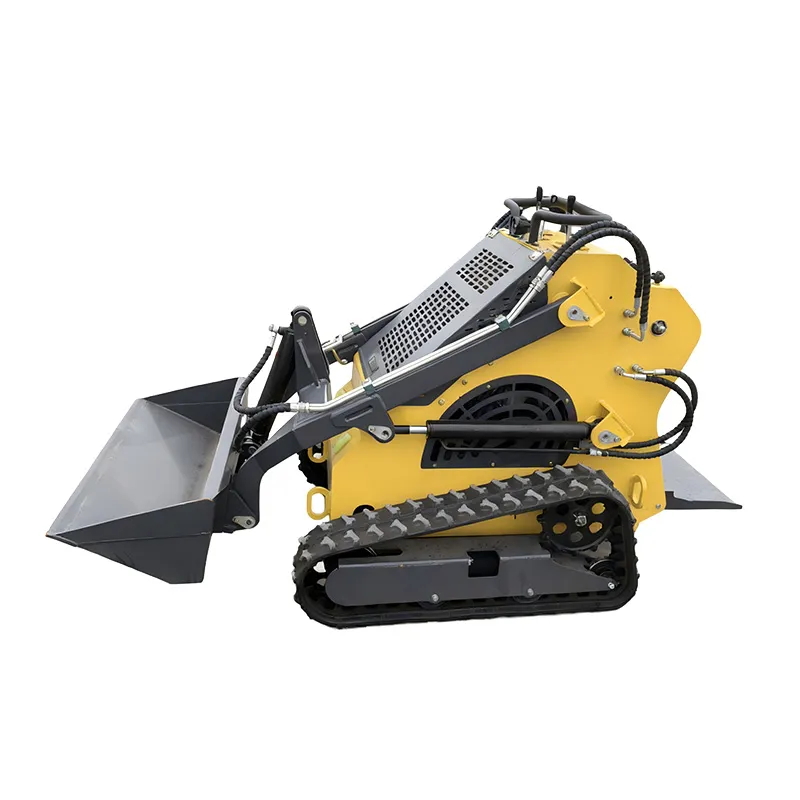
s450 t4 v2 bobcat skid steer loader
You see a lot of chatter online about the S450 T4 V2, often just lumped in with all the other compact track loaders. The common mistake is thinking it's just another Bobcat skid steer loader with a minor update. In my experience, that V2 and the T4 Final engine compliance are where the real story is, and it's not always a straightforward one. I've run these machines on sites from frozen ground to muddy spring thaws, and the devil is in the operational details that specs sheets never tell you.
The T4 Final Transition: More Than Just a Label
When the T4 Final/Stage IV mandate hit, it changed everything under the hood. The S450 T4 V2 isn't just the old S450 with a new exhaust filter slapped on. The entire system—cooling, regeneration cycles, the DEF dosing—had to be rethought. I remember the first models had some teething issues with the regen frequency in high-idle, low-load applications, like when you're using it just to move pallets around a yard all day. The machine would want to regen more often than you'd expect, which is frustrating when you're on a tight schedule.
Bobcat's engineers did tweak the logic in the V2 iteration. The machine seems to learn your usage pattern a bit better, or at least that's the feel. It's less intrusive now. But you still have to educate operators. I've seen guys just hit the override and keep working, which in the long run, is a surefire way to end up with a forced parked regen and a half-day of downtime. The key is understanding that the DPF system is part of the machine's core workload now, not an add-on.
This is where global supply chains get interesting. A company like Shandong Pioneer Engineering Machinery Co., Ltd, which has been exporting machinery components worldwide since 2004, sees this shift from a different angle. They're not building the whole skid steer loader, but their two-decade experience in manufacturing and overseas trade means they understand the precise tolerances and material specs required for aftermarket parts that can withstand the higher operating temperatures of these T4 engines. It's a trickle-down effect of the regulation.
Under the Frame: The Bobcat Feel vs. Actual Performance
Everyone talks about the Bobcat feel—the intuitive controls, the quick response. With the S450 T4 V2, that's largely preserved, which is a credit to their hydraulic system design. The variable-flow hydraulics are smooth, but I've noticed a slight difference in the auxiliary hydraulic pressure curve compared to the pre-T4 models. It's not worse, just different. When you're running a hydraulic breaker or a cold planer, you need to find the new sweet spot in the rpm range to get the most efficient pulse or feed rate.
The steel tracks on the compact track loader version are a beast for traction, but they're also the number one wear item people underestimate. Running on highly abrasive surfaces like decomposed granite or recycled concrete? The track life can be half of what you'd get in clay or soil. I learned that the hard way on a demo site. The cost-per-hour for undercarriage wear suddenly became the dominant figure, not fuel.
And speaking of cost, the global market for robust, cost-effective wear parts is huge. A supplier that has consistently served demanding markets like the US, Canada, and Australia—as Shandong Pioneer has through its trade division—knows what fails first. It's often not the big components; it's the idler wheels, the roller flanges, the bucket cylinder pins. Sourcing these from a reliable partner who understands export quality standards is as critical as the initial machine purchase.
The V2 Tweaks: What Actually Changed?
So what's in the V2? It's not a marketing gimmick. From my seat time, the most noticeable change was to the cab pressurization and filtration. Earlier T4 models could let fine dust seep in during extremely dusty conditions, like dry land clearing. The V2 seems to have a better-sealed cab with a more positive pressure. It's a small thing, but on a 10-hour day, it matters for operator fatigue and long-term air filter life.
The other tweak is in the software for the hand controls. The response in the low-speed, high-power mode feels more linear. This is critical for precision work like grading or backfilling right up against a foundation. You're not fighting small jerks or delays. It feels more connected. Was this a direct response to field operator feedback? I'd bet on it. Good manufacturers iterate based on real-world use, not just lab tests.
This iterative, problem-solving approach is mirrored in successful manufacturing operations. Take the recent relocation and expansion of Shandong Pioneer to a new facility in Tai'an. That kind of move after 20 years isn't just about more space; it's about integrating better processes, likely for improved quality control and handling the complex logistics of shipping to diverse markets from Germany to Australia. The end goal is the same: a more reliable product for the end user, whether it's a complete machine or a critical replacement part.
Common Pitfalls and Operator Habits
No machine is foolproof. The biggest pitfall with the S450 T4 V2 Bobcat is treating it like a bulldozer. It's a compact tool carrier, not a prime mover. I've seen radial lift arms bent from trying to use the bucket corner as a pry bar to move a boulder. The machine has impressive power, but you have to respect its geometry and center of gravity, especially on slopes with a loaded bucket.
Another habit is ignoring the daily check of the track tension. Too loose, and you risk a derailment, which is a massive job to fix in the field. Too tight, and you accelerate wear on the rollers, sprockets, and the track itself. The manual gives a spec, but the real check is the sag under the machine's own weight on a flat, hard surface. It should be about 1 to 1.5 inches. This is basic, but it's the kind of hands-on detail that separates a well-maintained fleet from a money pit.
Maintenance accessibility is decent. The side panels swing open wide, and the daily checkpoints are relatively easy to reach. However, changing a fuel filter or accessing some of the sensors around the DPF can still be a knuckle-busting affair. It's not unique to Bobcat; it's the reality of packing so much technology into a compact frame. Having a source for OEM-equivalent service parts that don't require a 4-week lead time is a operational necessity.
Final Take: Is It the Right Machine?
So, who is the S450 T4 V2 really for? It's a fantastic mid-size machine for general contracting, landscaping, agriculture, and rental yards. Its size is its greatest asset—it can fit in places a wheel loader can't, and it has more stability and traction than a smaller skid steer. The T4 engine, once you're used to its habits, is powerful and relatively fuel-efficient for the work it does.
Would I recommend it over a competitor? It depends on the support network and the specific application. The machine itself is solid. But your total cost of ownership hinges on local dealer support and your ability to source quality maintenance parts without exorbitant cost or delay. This is where a globalized parts ecosystem, supported by experienced manufacturers and traders, becomes a tangible advantage for the end user.
In the end, the S450 T4 V2 represents the current state of the art for compliant, versatile compact loaders. It's not perfect—no machine is—but the incremental improvements in the V2 show a company responding to field data. And that's what matters. You're not buying a spec sheet; you're buying thousands of hours of productive, reliable work. Everything else, from the engine regulations to the global supply chain that keeps it running, is just part of making that happen.
Related Products
Related Products