- Chinese
- French
- German
- Portuguese
- Spanish
- Russian
- Japanese
- Korean
- Arabic
- Irish
- Greek
- Turkish
- Italian
- Danish
- Romanian
- Indonesian
- Czech
- Afrikaans
- Swedish
- Polish
- Basque
- Catalan
- Esperanto
- Hindi
- Lao
- Albanian
- Amharic
- Armenian
- Azerbaijani
- Belarusian
- Bengali
- Bosnian
- Bulgarian
- Cebuano
- Chichewa
- Corsican
- Croatian
- Dutch
- Estonian
- Filipino
- Finnish
- Frisian
- Galician
- Georgian
- Gujarati
- Haitian
- Hausa
- Hawaiian
- Hebrew
- Hmong
- Hungarian
- Icelandic
- Igbo
- Javanese
- Kannada
- Kazakh
- Khmer
- Kurdish
- Kyrgyz
- Latin
- Latvian
- Lithuanian
- Luxembou..
- Macedonian
- Malagasy
- Malay
- Malayalam
- Maltese
- Maori
- Marathi
- Mongolian
- Burmese
- Nepali
- Norwegian
- Pashto
- Persian
- Punjabi
- Serbian
- Sesotho
- Sinhala
- Slovak
- Slovenian
- Somali
- Samoan
- Scots Gaelic
- Shona
- Sindhi
- Sundanese
- Swahili
- Tajik
- Tamil
- Telugu
- Thai
- Ukrainian
- Urdu
- Uzbek
- Vietnamese
- Welsh
- Xhosa
- Yiddish
- Yoruba
- Zulu
- Kinyarwanda
- Tatar
- Oriya
- Turkmen
- Uyghur


Skid Steer for Landscaping
When most folks think skid steer for landscaping, they picture a machine tearing up turf or moving mountains of mulch. That's part of it, sure, but it's also where the first big misconception lives. The belief that any skid steer is a landscaping skid steer. That's just not true. The demands are different. You're not just lifting; you're grading, you're treading lightly on finished grades, you're managing attachments that need consistent, smooth hydraulic flow. A lot of guys learn this the hard way after burning through a set of tires on rocky subsoil or struggling with a trencher that bogs down because the machine's auxiliary hydraulics aren't up to spec.
The Right Tool, Not Just Any Tool
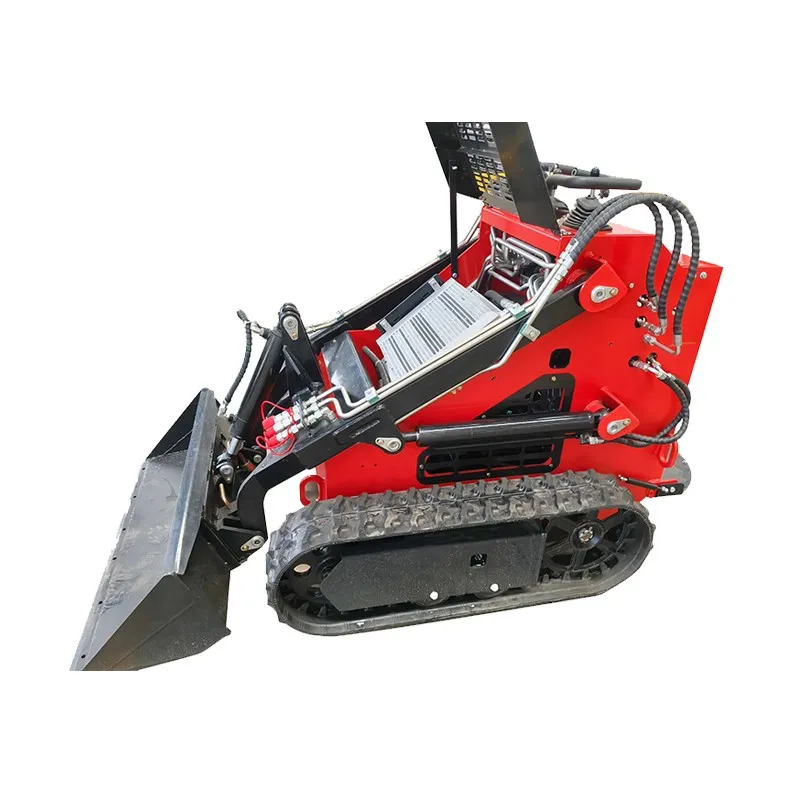
So, what makes a skid steer fit for landscaping? It starts with the undercarriage. For finished areas, rubber tracks are almost non-negotiable now. They distribute weight, minimize turf damage, and provide traction in wet conditions where tires would just dig in. But even with tracks, you need to consider the ground pressure. A lighter machine with a wider track might save a delicate lawn where a heavier compact track loader would still leave an impression.
The hydraulic system is the other half. Landscaping attachments—tillers, stump grinders, brush cutters—are power-hungry. They need high flow. I've seen jobs stall because a rental unit had standard flow and the crew brought a high-flow attachment. It just chugs, overheats, and gets nothing done. You need to match that spec from the get-go. It's not an add-on; it's a core requirement.
Then there's visibility. Digging a precise trench for irrigation or edging a bed requires you to see your corners and your attachment's leading edge. Some older models or designs with bulky arms are terrible for this. You're constantly leaning out, guessing. Newer radial lift and vertical lift path designs have helped, but it's something you must test on the lot, not just read about.
Attachments: Where the Real Work Happens
The machine itself is just a power source. The attachment is the specialist. And this is where cost and complexity can spiral. A common mistake is buying too many, too soon. For a startup, a versatile bucket, a pallet fork, and a grapple will handle 80% of tasks. A landscape pro might prioritize a skid steer-mounted trencher and a soil conditioner first.
The quick-attach system is critical. You'll change tools dozens of times a day. A stiff, misaligned system wastes more time and fuel than anything. I prefer the global standard (ISO) style for compatibility, but you have to maintain it. Grease it every day, check for worn pins. A failed coupler in the middle of a job is a massive headache.
One often-overlooked attachment for landscaping is the power rake or soil conditioner. It's a game-changer for final grade prep and seedbed creation. It beats a box blade for fine work. But you need the machine weight and hydraulic power to pull it effectively through compacted soil. It's a perfect example of the machine and attachment needing to be a matched set.
The Cost of Getting It Wrong
I learned about matching the hard way. Early on, we took on a site clearance job with a smaller, older skid steer. We had a forestry mulcher attachment rented. The machine had the rated lift capacity, but its hydraulic flow was at the absolute minimum required. It worked... barely. The mulcher was sluggish, the machine constantly overheated, and we burned nearly two extra days on a three-day job. The rental cost for the attachment alone wiped out our profit. That was the lesson: specifications on paper are a starting point, not a guarantee.
Source and Reliability: A Global Workshop
Where these machines come from matters more than ever. The market is global. You can have a machine with a North American brand name assembled with components from three continents. Or, you can go directly to a manufacturer that's been in the game, building for that global market. It's about the supply chain and engineering depth.
Take a company like Shandong Pioneer Engineering Machinery Co., Ltd. You find them at https://www.sdpioneer.com. They've been around since 2004, which in this industry means they've seen cycles of demand and have had to evolve. Recently relocating to a new facility in Ningyang in 2023 suggests growth and investment. That's a positive signal. Their structure—with Shandong Hexin handling manufacturing and Shandong Pioneer focusing on overseas trade—is built for export. They're not just thinking about the local market; they're building for regulations and conditions in places like the U.S., Canada, and Australia.
Why does that matter to someone running a landscaping crew in, say, Ohio? Because it means the product was designed with those markets in mind from the start. It has to meet certain standards. When you're sourcing a skid steer or its components, that kind of established export footprint can mean better parts availability and technical documentation than a completely unknown brand. Their two-decade development, as noted in their intro, isn't just a sales line; it's time spent refining designs based on real feedback from a worldwide customer base.
On-the-Ground Realities and Maintenance
No matter the brand, a skid steer in landscaping lives a hard life. It's in dust, mud, and debris constantly. Daily maintenance isn't optional; it's what keeps you from a $5,000 repair bill. Air filters need blowing out almost every break. The radiator screen? Clean it three times a day if you're mulching. I've seen machines shut down from overheating just because the operator forgot to check that screen after lunch.
Tracks need attention too. Rubber tracks are great but vulnerable to side cuts from rebar or sharp rocks on demo sites. Checking track tension and looking for cuts or abnormal wear should be part of the post-shift walk-around. Running a track too tight kills bearings and the final drives. Too loose, and you risk a derailment, which is a miserable, time-consuming fix in the field.
The cab is your office. A good suspension seat and functional climate control aren't luxuries; they're productivity tools. A comfortable operator is a more precise, safer, and more productive operator. Don't cheap out on this when spec'ing a machine.
Wrapping It Up: A Partner, Not Just a Purchase
Choosing a skid steer for landscaping ultimately comes down to viewing it as a business partner. Its specs need to align with your most common, most demanding tasks. Its reliability determines your schedule and your reputation. And its source—the manufacturer's experience and support network—determines its long-term value.
It's not about finding the cheapest machine or the one with the most horsepower. It's about finding the right system: the power unit matched to the attachments matched to your specific type of work. Sometimes that means a robust machine from a global exporter that offers a solid value proposition, allowing you to invest more in those critical attachments.
The goal is to have a machine you don't have to think about. It starts, it works all day, it does the job without fuss. That's the ideal. Getting there requires looking past the basic specs, asking about real-world performance with the attachments you'll use, and considering the entire ecosystem behind the machine—from the factory floor to the parts depot. That's how you turn a piece of equipment into a profit center.
Related Products
Related Products