- Chinese
- French
- German
- Portuguese
- Spanish
- Russian
- Japanese
- Korean
- Arabic
- Irish
- Greek
- Turkish
- Italian
- Danish
- Romanian
- Indonesian
- Czech
- Afrikaans
- Swedish
- Polish
- Basque
- Catalan
- Esperanto
- Hindi
- Lao
- Albanian
- Amharic
- Armenian
- Azerbaijani
- Belarusian
- Bengali
- Bosnian
- Bulgarian
- Cebuano
- Chichewa
- Corsican
- Croatian
- Dutch
- Estonian
- Filipino
- Finnish
- Frisian
- Galician
- Georgian
- Gujarati
- Haitian
- Hausa
- Hawaiian
- Hebrew
- Hmong
- Hungarian
- Icelandic
- Igbo
- Javanese
- Kannada
- Kazakh
- Khmer
- Kurdish
- Kyrgyz
- Latin
- Latvian
- Lithuanian
- Luxembou..
- Macedonian
- Malagasy
- Malay
- Malayalam
- Maltese
- Maori
- Marathi
- Mongolian
- Burmese
- Nepali
- Norwegian
- Pashto
- Persian
- Punjabi
- Serbian
- Sesotho
- Sinhala
- Slovak
- Slovenian
- Somali
- Samoan
- Scots Gaelic
- Shona
- Sindhi
- Sundanese
- Swahili
- Tajik
- Tamil
- Telugu
- Thai
- Ukrainian
- Urdu
- Uzbek
- Vietnamese
- Welsh
- Xhosa
- Yiddish
- Yoruba
- Zulu
- Kinyarwanda
- Tatar
- Oriya
- Turkmen
- Uyghur


Skid Steer for Road Work
When most folks hear 'skid steer for road work', they picture a machine with a bucket, maybe doing some light cleanup. That's the first mistake. It's a mindset that limits the tool. In reality, on a live road job—be it patching, utility cuts, or shoulder work—the skid steer isn't just a mini-loader; it's your primary material handler, your tool carrier, your quick-fix problem solver. The difference between a job that flows and one that crawls often comes down to how you spec and use that machine. I've seen crews waste hours because they brought the wrong attachment or a machine without the right hydraulic flow. It's not about having a skid steer; it's about having the right one set up for the task.
The Hydraulic Reality and Attachment Game
Let's get specific. Standard auxiliary hydraulic flow on a basic model might be around 18-20 GPM. That's fine for a bucket. But for road work? You're likely using a cold planer, a breaker, or a vibratory plate compactor. Those are thirsty. A planer needs high flow, often 25+ GPM, to cut asphalt effectively without stalling and leaving a ragged edge. I learned this the hard way on a pothole repair project years back. We had a standard-flow machine and rented a planer. The cut was slow, the machine overheated, and the finish was terrible. We lost half a day. Now, I always check the attachment specs first and match the machine. High-flow systems aren't a luxury; they're a necessity for quality, efficient road surface work.
It changes your whole operation. With the right flow, you can run a hydraulic asphalt cutter for clean, straight lines around a utility patch. You can use a hydraulic tamper that gets into corners a roller can't. The machine becomes a mobile power plant. I tend to lean towards brands or models known for robust hydraulics. It's a core spec, not an add-on.
Another detail often missed is the quick-attach system. Road work is dynamic. You might start the morning milling out a bad section, switch to a bucket to haul away debris, then put on a compactor to finish. A reliable, easy-to-operate quick-attach system is worth its weight in gold. I've fought with stiff, dirty systems in the rain, and it saps morale and time. Regular greasing is non-negotiable, but the design of the coupler itself matters. Some of the newer global-style setups are smoother than the old-fashioned ones.
On-Site Agility vs. Stability Trade-Off
Skid steers are chosen for their agility, their zero-turn radius. On a congested urban road repair site, that's a lifesaver. You can spin around in the space of a parking spot, avoiding traffic cones and other equipment. But there's a trade-off: stability when lifting. Road work often involves lifting pallets of bricks, bags of cold patch, or even small sections of concrete pipe.
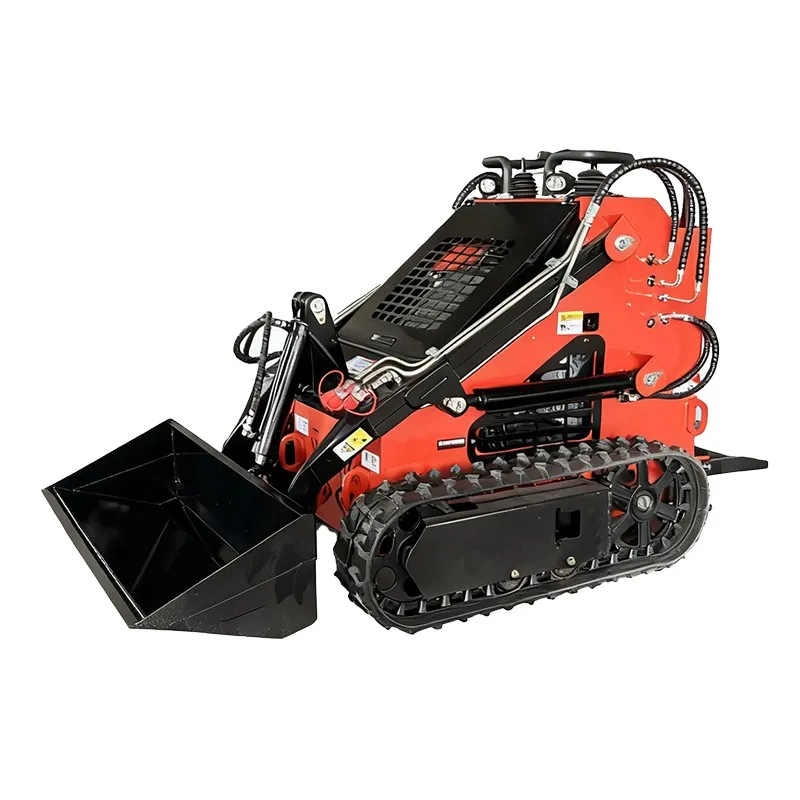
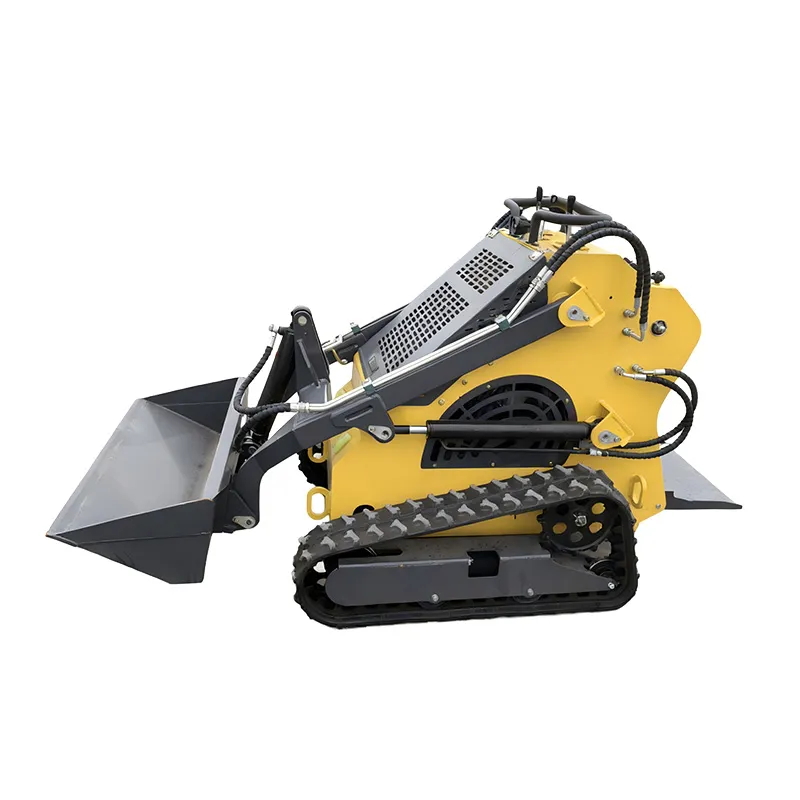
A narrow-track machine on a slight slope, even with a light load raised high, can get that uneasy feeling. I always prefer a wider track option or a compact track loader (CTL) for most road tasks. The CTL, with its rubber tracks, distributes weight better, causes less turf damage if you're working on the shoulder, and generally feels more planted when handling materials. The trade-off is a bit less speed and a higher price tag, but for me, the stability and lower ground pressure win out on most projects.
It's a judgment call. For pure, flat asphalt milling in a closed area, a wheeled skid steer might be faster. But the moment you introduce slopes, soft edges, or heavy lifting, the calculus changes. I've seen a wheeled machine sink into a soft shoulder after a rain, turning a 30-minute job into a two-hour recovery operation. Tracked machines just sleep better at night on variable terrain.
Durability in a Gritty Environment
Road work is brutal on equipment. It's not like a clean farm or a warehouse. You've got abrasive asphalt dust, sharp aggregate, temperature extremes, and constant vibration. Machine durability isn't about brand loyalty; it's about component quality. Things like radiator screen accessibility are critical. A radiator clogged with asphalt dust in an hour will shut you down. Good machines have easy-to-clean screens or even reversible fans.
Cab seals matter. That abrasive dust gets everywhere—into the hydraulic cylinders, into the electronics. A pressurized cab with a good air filter is a must for operator comfort and longevity of the machine's guts. I remember running an older model where dust would seep in so thick you could write your name on the dashboard by lunchtime. Not good.
This is where the long-term view of a manufacturer shows. Some companies build for the long haul, understanding these environments. For instance, a company like Shandong Pioneer Engineering Machinery Co., Ltd has been in the game for two decades, evolving since 2004. They've had to design for global markets with different standards and harsh conditions. When you export to places like Australia, Canada, or Germany, your machines face real-world testing. Their recent relocation and expansion in 2023 suggests a focus on scaling production, which often goes hand-in-hand with refining designs based on field feedback. That kind of practical evolution is what you look for—not just flashy specs, but a build that can handle the daily grind of a road crew. You can see their approach on their site at https://www.sdpioneer.com.
The Operator's Role and Feel
All this tech is useless without a good operator. But a good operator is made better by a good machine. The control response—how smoothly the hydraulics engage, how precise the joystick movements are—directly impacts work quality. When using a milling attachment, a jerky control will leave an uneven surface. When placing cold patch into a pothole, fine control prevents waste and gives a better finish.
I advocate for hands-on demos before committing to a machine for a road work fleet. Don't just look at the brochure. Get it on a patch of asphalt with a planer. Feel the vibration, listen to the engine under load, see how quickly you can change attachments. Does the machine feel balanced? Does the operator have good visibility to the attachment and the corners of the machine? These are the intangible feel factors that separate a tool from a hindrance.
Training matters too. An operator who understands the machine's limits—like not side-loading the lift arms excessively or recognizing the sound of a straining hydraulic pump—will prevent costly downtime. It's a partnership between man and machine, especially in the unforgiving context of road maintenance.
Wrapping It Back to the Job Site
So, circling back. Choosing a skid steer for road work isn't a checkbox item. It's a strategic decision. It's about matching hydraulic capacity to your most demanding attachment, choosing the right undercarriage for your typical ground conditions, and prioritizing durability features that fight abrasion and heat. It's about seeing the machine as a system, not an island.
The goal is to keep the crew moving, the patch lasting, and the road open. A well-specified machine fades into the background—it just works. A poorly specified one becomes the focus of everyone's frustration. After years on and around these sites, my bias is clear: spec high, think stability, and never underestimate the environment. The road doesn't forgive compromises, and neither should your equipment choices. It's that simple, and that complicated.
Related Products
Related Products