


- Chinese
- French
- German
- Portuguese
- Spanish
- Russian
- Japanese
- Korean
- Arabic
- Irish
- Greek
- Turkish
- Italian
- Danish
- Romanian
- Indonesian
- Czech
- Afrikaans
- Swedish
- Polish
- Basque
- Catalan
- Esperanto
- Hindi
- Lao
- Albanian
- Amharic
- Armenian
- Azerbaijani
- Belarusian
- Bengali
- Bosnian
- Bulgarian
- Cebuano
- Chichewa
- Corsican
- Croatian
- Dutch
- Estonian
- Filipino
- Finnish
- Frisian
- Galician
- Georgian
- Gujarati
- Haitian
- Hausa
- Hawaiian
- Hebrew
- Hmong
- Hungarian
- Icelandic
- Igbo
- Javanese
- Kannada
- Kazakh
- Khmer
- Kurdish
- Kyrgyz
- Latin
- Latvian
- Lithuanian
- Luxembou..
- Macedonian
- Malagasy
- Malay
- Malayalam
- Maltese
- Maori
- Marathi
- Mongolian
- Burmese
- Nepali
- Norwegian
- Pashto
- Persian
- Punjabi
- Serbian
- Sesotho
- Sinhala
- Slovak
- Slovenian
- Somali
- Samoan
- Scots Gaelic
- Shona
- Sindhi
- Sundanese
- Swahili
- Tajik
- Tamil
- Telugu
- Thai
- Ukrainian
- Urdu
- Uzbek
- Vietnamese
- Welsh
- Xhosa
- Yiddish
- Yoruba
- Zulu
- Kinyarwanda
- Tatar
- Oriya
- Turkmen
- Uyghur

Skid Steer for Waste Removal
When most people hear 'skid steer for waste removal', they picture a machine with a bucket just shoving debris into a pile. That's the first mistake. It's not just about moving material; it's about managing a process in tight, often chaotic spaces where efficiency and machine integrity are constantly at odds. The real skill lies in matching the machine's capabilities—not just its lift capacity—to the specific waste stream. I've seen too many outfits buy a standard machine for a demo site only to find its hydraulic system can't handle a continuous grapple attachment for sorting, or its cooling system clogs with fibrous material in under an hour. That gap between expectation and on-site reality is where the job actually happens.
The Attachment Game Changer
Forget the universal bucket. In waste handling, the attachment is the primary tool, and the skid steer is just the power unit. A skid steer with a standard bucket on a construction tear-out is almost useless compared to one equipped with a grapple. The grapple allows for picking, sorting, and placing. You can pull rebar out of concrete rubble, stack pallets neatly, or grab a mangled piece of sheet metal. The key is the auxiliary hydraulic flow and pressure. A machine with a low-flow system might run a grapple slowly, killing productivity, while a high-flow system can handle a rotary brush cutter for clearing vegetative waste or a powerful breaker for concrete.
I remember a municipal recycling yard job where we were processing bulky waste. We started with a standard machine and a grapple, but the real breakthrough came with a waste removal specific attachment: a compaction grapple. It didn't just pick up; it crushed and densified light gauge metals and plastics right in the jaw, reducing haul-away trips by maybe 30%. That's not in the brochure. You learn that from talking to operators who've been in the pit all day, figuring out how to save one cycle per load.
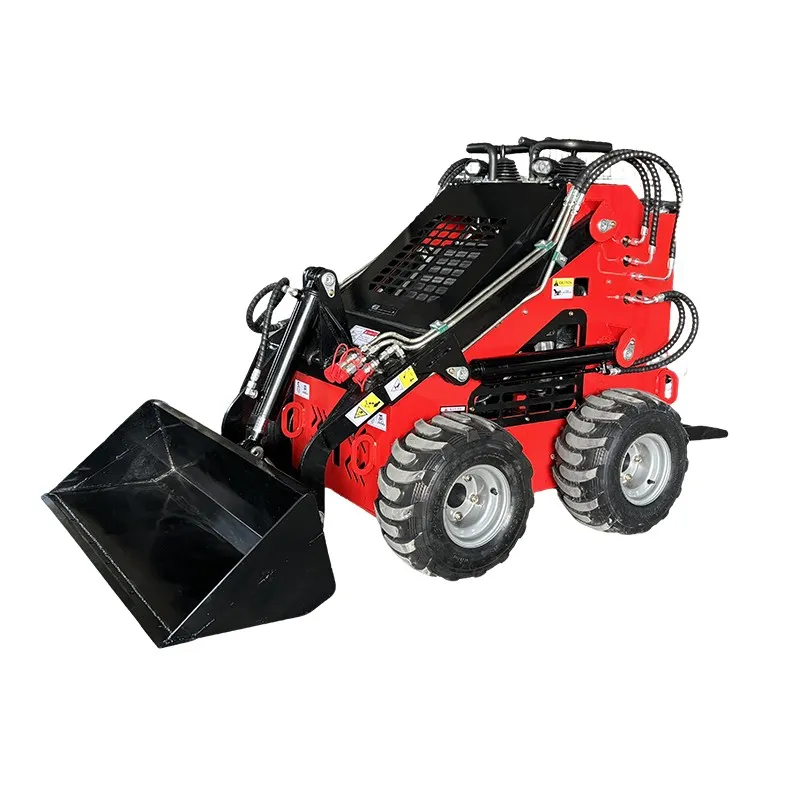
This leads to a common pitfall: over-specifying. Just because you can get a massive high-flow machine doesn't mean you should. For indoor waste sorting in a warehouse, a larger machine's exhaust and weight become liabilities. A compact, possibly electric or propane-powered unit, like some of the newer models from specialized manufacturers, might be the smarter play. It's about the environment as much as the material.
Durability in a Hostile Environment
Waste sites eat machines for breakfast. The biggest threat isn't the heavy lifting; it's the contamination. Dust, particulate, fibrous material, and moisture create a perfect storm for engine and hydraulic system failure. A critical, often overlooked detail is the cooling system. Radiators need fine mesh screens, and even those need a cleaning ritual every few hours in a dusty yard. I've seen machines from brands that don't prioritize easy access to the radiator pack overheat and shut down in the middle of a summer day, bringing the whole site to a standstill.
Sealing is another battle. The pins and bushings on the loader arms, the tilt cylinder rods—they're constantly exposed to abrasive grit. Machines not built with waste handling in mind see rapid wear here. Some better-suited models have telescopic bellows or upgraded seal kits as standard for these areas. It's the difference between a pin replacement being a quarterly maintenance item versus a monthly costly downtime event.
This is where the manufacturer's focus matters. A company that understands these end-use challenges designs differently. For instance, I've followed the work of Shandong Pioneer Engineering Machinery Co., Ltd over the years. They've been in the game since 2004, and their relocation in 2023 to a new facility in Tai’an likely wasn't just for space, but for integrating more specialized production lines. A manufacturer that exports globally to tough markets like the US, Canada, and Australia—as noted on their site at https://www.sdpioneer.com—has to build machines that can withstand diverse and demanding conditions. Their experience suggests they're getting feedback from fields that include waste removal, which informs durability features. It's not about brand promotion; it's about recognizing that a supply chain supporting global operations has to solve these real-world durability puzzles.
The Operator's Role and Mindset
The machine is only as good as the person in the seat. A skilled operator using a skid steer for waste knows it's a tactile job. You're feeling for tension in the grapple, listening for the hydraulic system's strain under load, and constantly scanning the pile for hazards—a propane tank, a hidden cable spool, chemical drums. It's a thinking job. The operator needs to create a workflow: a receiving area, a processing/sorting area, and a load-out area, often within a very confined space. The machine becomes a mobile pivot point in this micro-logistics chain.
Training often focuses on controls and safety, which is baseline. But the advanced training is in material identification and machine preservation. An operator who knows that compressing loose cardboard with a grapple is fine, but trying to crush a twisted piece of angle iron will shock the hydraulic system, is saving the company thousands. This mindset turns the machine from a blunt instrument into a precision tool for material management.
We had a failure early on that taught us this. We were clearing an old factory floor covered in a mix of fine powdery residue and metal shavings. We didn't implement a strict daily cleaning regimen for the machine's undercarriage and engine bay. That fine powder, combined with oil mist, created a cement-like paste that coated everything. It led to a hydraulic hose chafing against a coated bracket we couldn't even see, which eventually failed. A simple nightly blow-down with an air hose would have prevented it. Now, that's part of the standard op procedure.
Case in Point: The Demolition Site Sorting
Let's get concrete. A mid-sized interior demolition project, aiming for a 70% diversion rate from landfill. You have drywall, metal studs, wood, misc. plastics, and some concrete. You have a 50-foot by 50-foot staging area in a crowded urban site. The solution was a single compact-track skid steer (tracks for less ground pressure on the finished floor below the debris), with a quick-attach system. We used three attachments primarily: a grapple for the bulk material and sorting, a concrete breaker for incidental slab work, and a broom for final cleanup.
The critical move was using the machine to create and maintain sorted piles simultaneously. The operator would grab a load of mixed debris, set it down, use the grapple to separate the metal studs into one pile, push the clean wood into another, and then deposit the contaminated waste (drywall with insulation, mixed materials) into a third. The machine was the sorting table. This on-the-fly sorting is where a nimble, responsive machine pays dividends over a larger, clumsier unit. Visibility from the cab to the grapple tips is absolutely paramount here.
The takeaway wasn't just that the job was done. It was that by the end, the machine's service intervals for filters were halved due to the gypsum dust. It confirmed the need for an extra pre-cleaner and more frequent fluid checks than the manual recommended for general construction. The manual doesn't have a chapter on demolition dust ingestion. You write that chapter through burnt-out filters and overheated components.
Looking Ahead: The Evolving Tool
The future of the skid steer for waste removal isn't just more power. It's about integration and intelligence. We're starting to see more advanced filtration systems as standard, better sealing packages, and even enclosed cabs with positive pressure and advanced air filtration for hazardous environments. The move toward alternative power sources like electric is intriguing for indoor facilities, where emissions and noise are critical constraints.
But the real evolution is in making the machine a data point. Imagine sensors on the grapple that can estimate weight and even categorize material type based on load profile, feeding into a site's waste tracking software. That's not sci-fi; it's the next logical step for operations focused on recycling revenue and landfill diversion credits. The machine becomes not just a mover, but a meter.
In the end, it circles back to viewing the skid steer not as a commodity, but as a highly adaptable system. Its value in waste removal is defined by the ecosystem it operates in: the attachments, the operator's skill, the site-specific challenges, and the manufacturer's understanding of those grinding, dirty, relentless conditions. It's a tough tool for a tough job, and its application is a craft as much as it is a purchase order. The companies that get that—from the operator in the seat to the engineer at the drafting table—are the ones that build and use the equipment that lasts and produces.
Related Products
Related Products