- Chinese
- French
- German
- Portuguese
- Spanish
- Russian
- Japanese
- Korean
- Arabic
- Irish
- Greek
- Turkish
- Italian
- Danish
- Romanian
- Indonesian
- Czech
- Afrikaans
- Swedish
- Polish
- Basque
- Catalan
- Esperanto
- Hindi
- Lao
- Albanian
- Amharic
- Armenian
- Azerbaijani
- Belarusian
- Bengali
- Bosnian
- Bulgarian
- Cebuano
- Chichewa
- Corsican
- Croatian
- Dutch
- Estonian
- Filipino
- Finnish
- Frisian
- Galician
- Georgian
- Gujarati
- Haitian
- Hausa
- Hawaiian
- Hebrew
- Hmong
- Hungarian
- Icelandic
- Igbo
- Javanese
- Kannada
- Kazakh
- Khmer
- Kurdish
- Kyrgyz
- Latin
- Latvian
- Lithuanian
- Luxembou..
- Macedonian
- Malagasy
- Malay
- Malayalam
- Maltese
- Maori
- Marathi
- Mongolian
- Burmese
- Nepali
- Norwegian
- Pashto
- Persian
- Punjabi
- Serbian
- Sesotho
- Sinhala
- Slovak
- Slovenian
- Somali
- Samoan
- Scots Gaelic
- Shona
- Sindhi
- Sundanese
- Swahili
- Tajik
- Tamil
- Telugu
- Thai
- Ukrainian
- Urdu
- Uzbek
- Vietnamese
- Welsh
- Xhosa
- Yiddish
- Yoruba
- Zulu
- Kinyarwanda
- Tatar
- Oriya
- Turkmen
- Uyghur


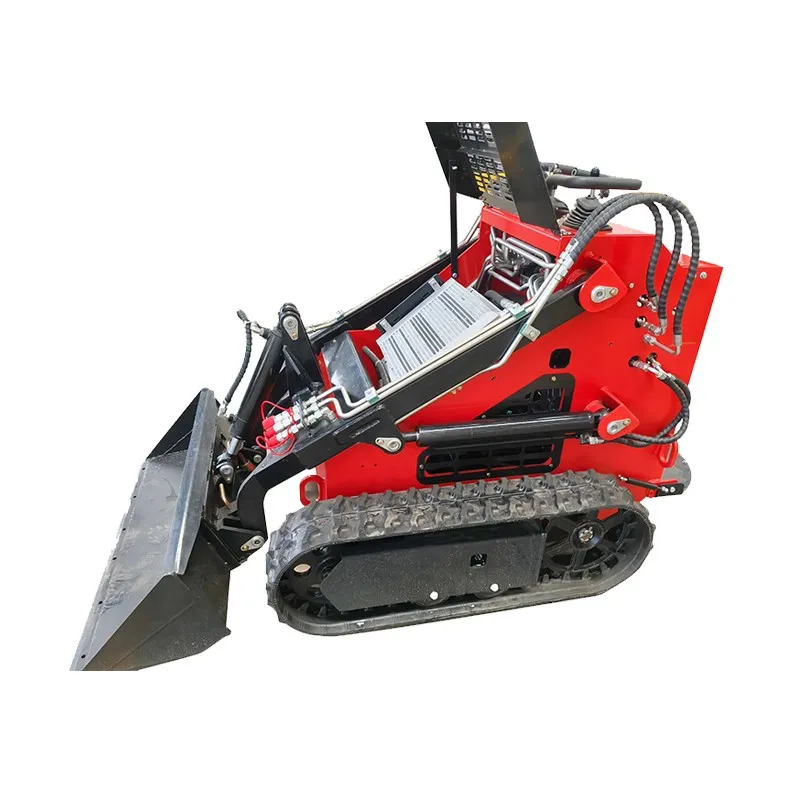
skid steer track loader attachments
When you hear 'skid steer track loader attachments', most folks jump straight to the big three: buckets, augers, grapples. That's the surface. The real conversation, the one that happens between operators over coffee, is about the fit, the wear, the unexpected bind-up on a Tuesday morning when you're already behind schedule. It's not just about what it does, but how it fails, and how you adapt.
The Myth of Universal Compatibility
Let's get this out of the way first. That universal quick-attach plate? It's a starting point, not a guarantee. I've seen machines, even from the same brand in consecutive model years, with slight variations in the hydraulic flow rate or pressure relief settings. Slap on a high-flow skid steer track loader attachments like a mulcher or a cold planer without checking, and you're either starving it for power or risking a catastrophic over-speed. The manual has the numbers, but nobody reads it until after the coupler blows. The lesson? Compatibility is a three-part check: mechanical hook-up, hydraulic match, and electrical/control interface. Miss one, and you're just renting a very expensive paperweight.
Take tilt-tach style couplers for third-function tools. The convenience is fantastic—until you're trying to connect an older attachment with slightly worn pins on a newer machine with a tighter tolerance. You end up rocking the machine, inching forward and back, cursing the half-millimeter of play that's just enough to prevent the lock. Some outfits, like Shandong Pioneer Engineering Machinery Co., Ltd, have gotten smart about this. Looking at their lineup, you can see they design for a range of the common QA specs, but they also offer the kits to adapt. It's a practical approach that acknowledges the messy reality of equipment yards worldwide.
And weight distribution. A track loader isn't a wheeled skid steer. The lower center of gravity and track footprint lets you handle heavier attachments, true. But cramming a massive pallet of bricks on a fork and lifting it full-height on a slight side slope? The stability feels different. The tracks dig in, but the sheer moment force on the attachment frame is immense. You develop a feel for it, a kind of seat-of-the-pants calculus that tells you when to reposition versus when to just go slow.
Hydraulics: The Lifeblood and the Headache
This is where the pros separate from the parts changers. Auxiliary hydraulics are the gateway to the most productive skid steer track loader attachments, but they're also a maintenance sink if ignored. Contamination is the silent killer. A new, shiny stump grinder or soil conditioner comes in, you hook it up to a machine with a slightly degraded hose or a seal that's starting to weep internally. Two weeks later, the attachment's valve bank is gunked up, it's cycling slow, and you're blaming the attachment maker.
I learned this the hard way early on. We ran a rotary tiller for landscape prep. Worked flawlessly for a season. Next spring, it was sluggish, wouldn't maintain constant rotor speed. We tore into the tiller's motor, replaced seals, the works. No fix. Finally, we put a flow meter on the host machine. The auxiliary circuit had lost nearly 15% of its flow due to a slowly failing pump. The attachment was the symptom, not the cause. Now, circuit flushing and regular hydraulic fluid analysis are non-negotiable before hooking up any high-value tool.
Then there's the question of third-function vs. standard auxiliary. For a grapple or a tilt bucket, standard aux is fine. But for a tree spade or a post driver that needs precise, independent control of multiple functions? You need a dedicated third-function kit with its own valve. The plumbing gets crowded fast, especially on compact track loaders where space is at a premium. Routing those lines away from heat sources and pinch points is an art form. I've seen beautifully engineered attachments rendered useless by a poorly routed hose that chafed through on the second day of work.
The Unsung Heroes: Specialized Attachments That Change the Game
Everyone talks about breakers and grapples. Let's talk about the less glamorous tools that quietly make money. Like a powered broom attachment. Not the manual angle kind, but the high-speed rotary one. For cleanup after paving or in tight urban demolition sites, it's irreplaceable. But the key is brush selection. A wire brush for heavy debris will destroy asphalt if you're not careful. A poly brush for light snow or leaves gets shredded on concrete rubble. You need a fleet of brushes, which is an extra cost nobody budgets for.
Or take trenchers. A compact track loader-mounted trencher is a beast for utility work. But the configuration is critical. Rear-mounted versus side-mounted changes the entire machine's balance and visibility. A rear-mount lets you see the trench line perfectly, but you're driving over the undisturbed ground, which can be soft. A side-mount keeps you on stable ground, but you're constantly craning your neck. There's no right answer, only the right answer for the specific job and operator preference.
This is where dealing with a manufacturer that has seen global applications pays off. A company like Shandong Pioneer, exporting to places as varied as Germany and Australia, has to account for different soil conditions, different safety regulations, and different operator habits. An attachment designed just for one market often has blind spots. The ones built for a wider audience tend to be more robust, with more adjustable guards, easier service points, and often, simpler designs that are harder to break. Their longevity comes from addressing problems that only show up after thousands of hours in the field, not just in a test lab.
Material and Build: Where Cost Cutting Shows
You can judge an attachment in the first five minutes of inspection, and it's not by the paint. Look at the weld quality. Is it consistent, clean, with proper penetration? Or is it globby, with spatter everywhere? Look at the cylinder mounts. Are they reinforced with gussets, or is it just a single plate welded on? The stress points on a skid steer track loader attachments are predictable: the hinge pins, the cylinder rod ends, the main structural welds where the tool meets the mounting plate.
I recall a bargain grapple bucket we bought years ago. The tines were thick, the steel looked good. Six months in, we started noticing hairline cracks along the back of the bucket, right where the cylinder mounts welded to the shell. The design had no fatigue relief, no allowance for the constant flexing. It was a static load design in a dynamic load world. We ended up having to weld massive reinforcement plates ourselves, which added weight and reduced capacity. The cheap price tag wasn't so cheap after all.
Abrasion is another tell. In applications like snow removal with a dozer blade or land clearing with a forestry cutter, the leading edges and wear plates take a beating. Good manufacturers use AR400 steel or better in these areas, and they design for easy replacement. The worst are the ones where the cutting edge is welded directly to the main moldboard. Once it's worn, you're cutting and grinding, trying to rebuild the entire structure. It's a maintenance nightmare. The catalog might say high-strength steel, but you need to ask which steel and where it's applied.
The Human Factor: Operator Training is an Attachment
This might be the most overlooked aspect. You can have the best-engineered attachment in the world, and an untrained operator will break it, or at least fail to get 50% of its potential value. It's not just about running the hydraulics. It's about understanding the tool's rhythm.
For example, running a hydraulic hammer. New operators tend to just hold the throttle open and lean on the trigger. They blow through bushings, crack mounting brackets, and destroy tool steel at an alarming rate. The right technique is a dance: applying steady downward pressure with the boom, but using short, rhythmic bursts of impact. Let the tool do the work. You can hear when it's working efficiently—it's a steady thud-thud-thud. When it's being abused, it's a frantic, high-pitched rattle.
Or consider a landscape rake. It seems simple. But knowing how to angle the tines for grading versus how to set them for debris collection, how to use the float function for a final finish pass—these aren't intuitive. They're learned. We started doing short attachment familiarization sessions whenever a new tool came on site. It saved us thousands in repair costs and downtime. The attachment isn't a standalone product; it's a system that includes the machine, the operator, and the task. Ignoring any part of that system leads to failure. In the end, the most critical attachment you can invest in isn't made of steel—it's the knowledge of the person in the seat.
Related Products
Related Products