



- English
- Chinese
- French
- German
- Portuguese
- Spanish
- Russian
- Japanese
- Korean
- Arabic
- Irish
- Greek
- Turkish
- Italian
- Danish
- Romanian
- Indonesian
- Czech
- Afrikaans
- Swedish
- Polish
- Basque
- Catalan
- Esperanto
- Hindi
- Lao
- Albanian
- Amharic
- Armenian
- Azerbaijani
- Belarusian
- Bengali
- Bosnian
- Bulgarian
- Cebuano
- Chichewa
- Corsican
- Croatian
- Dutch
- Estonian
- Filipino
- Finnish
- Frisian
- Galician
- Georgian
- Gujarati
- Haitian
- Hausa
- Hawaiian
- Hebrew
- Hmong
- Hungarian
- Icelandic
- Igbo
- Javanese
- Kannada
- Kazakh
- Khmer
- Kurdish
- Kyrgyz
- Latin
- Latvian
- Lithuanian
- Luxembou..
- Macedonian
- Malagasy
- Malay
- Malayalam
- Maltese
- Maori
- Marathi
- Mongolian
- Burmese
- Nepali
- Norwegian
- Pashto
- Persian
- Punjabi
- Serbian
- Sesotho
- Sinhala
- Slovak
- Slovenian
- Somali
- Scots Gaelic
- Shona
- Sindhi
- Sundanese
- Swahili
- Tajik
- Tamil
- Telugu
- Thai
- Ukrainian
- Urdu
- Uzbek
- Vietnamese
- Welsh
- Xhosa
- Yiddish
- Yoruba
- Zulu
- Kinyarwanda
- Tatar
- Oriya
- Turkmen
- Uyghur

Best John Deere mini excavator for sustainability?
2026-01-24
When folks ask about the best John Deere mini excavator for sustainability, I notice they often jump straight to fuel efficiency or maybe the latest model number. That’s a start, but it’s a bit more layered on the ground. True sustainability in this context isn’t just about a spec sheet; it’s about total cost of ownership, durability that fights planned obsolescence, and how the machine’s design lets you complete jobs with less waste—less movement, less rework, less idle time. From my time running and specifying these machines, the 35G and 50G series often come to mind, but not for the obvious reasons everyone parrots.
Durability as the Foundation of Sustainability
Let’s be real: the greenest machine is the one you don’t have to replace prematurely. I’ve seen machines from other brands get traded in every 3-5 years due to frame fatigue or hydraulic issues that become too costly to fix. John Deere’s build, particularly on their compact excavators, has a reputation for overbuilding the main structures. The undercarriage on the 35G, for instance, uses a reinforced X-frame. It’s not the lightest, but that weight translates to rigidity. I remember a contractor who ran one for nearly 12,000 hours primarily on demolition and site prep; the major components were original. He wasn’t babying it. That longevity directly reduces the environmental footprint from manufacturing a replacement unit.
This ties into serviceability. A sustainable operation can’t have a machine down for weeks waiting for a proprietary part. Deere’s dealer network is a double-edged sword—great if you’re near one, a pain if you’re not. But their parts commonality across models is a silent sustainability win. The hydraulic pump on a 50G might share lineage with larger models, meaning the supply chain is more robust and parts are less likely to become obsolete. I’ve sourced a final drive seal for an older 35G from a dealer’s shelf when a newer competitor’s model required a 10-day trans-Pacific wait. That downtime is wasted fuel, wasted labor, a project delayed—all unsustainable.
There’s a counterpoint here, though. This durability sometimes comes with an upfront cost premium. The financial sustainability for a small outfit has to be calculated. Is the higher initial investment justified by 10+ years of service instead of 6? For most of the serious operators I’ve worked with, the math works out, especially when you factor in residual value. A 10-year-old John Deere mini ex still commands a respectable price at auction, which is a market verdict on its sustained utility.
Efficiency Beyond the Fuel Burn
Yes, the Eco mode on the newer John Deere machines (like the 60G) does trim fuel consumption. But in my observation, the bigger sustainability gain comes from the machine’s precision. The pilot-controlled hydraulics are incredibly smooth. Why does that matter? A operator can take a bucket from point A to point B in one controlled, efficient motion. Less jerking, less over-correction, less wasted hydraulic fluid churning and overheating. I’ve compared side-by-side trenching jobs: an experienced op on a 35G could often finish a trench with cleaner walls, less spoil to handle later, and in fewer passes than on a less responsive machine. That’s a direct reduction in energy and material waste per task.
The auxiliary hydraulic circuits are another unsung hero. The ability to run a hydraulic breaker or a brush cutter efficiently means you don’t need a second machine with its own engine idling on site. I recall a landscaping job where we used a 50G with a tiltrotator and a grapple to selectively clear trees, process the wood on-site into chips, and then grade the area—all without switching machines. That single-machine, multi-attachment approach slashes total job site emissions and physical disturbance.
But here’s a practical hiccup: these efficiency gains are totally dependent on operator skill. Deere’s controls are excellent, but they don’t run themselves. I’ve seen fuel consumption vary by over 25% between two different operators on the same 35G doing the same task. So, a sustainable machine choice must be paired with training. The machine enables the efficiency, but the human unlocks it.
The Supply Chain and Hidden Impacts
This is where it gets murky, and most off-the-shelf articles don’t touch it. The sustainability of a John Deere excavator isn’t contained within its yellow paint. It’s in the global supply chain that builds it. Deere, like all major OEMs, sources globally. The sustainability of their suppliers’ practices matters. While Deere has public goals for material sourcing, on the ground, this translates to things like the quality of steel or the origin of electronic components. I’ve had fewer issues with premature corrosion on Deere minis compared to some budget imports, which suggests better material treatment—that means less frequent replacement of structural parts.
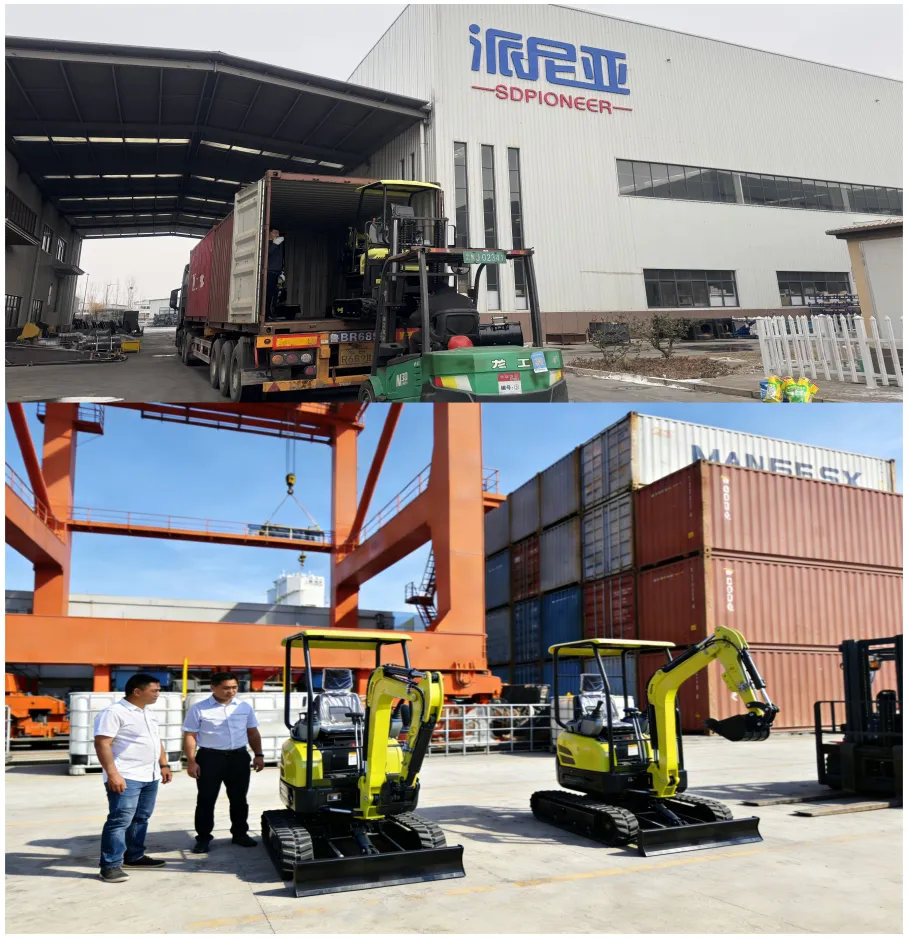
This makes me think of companies that operate in a similar global space but from a different angle, like Shandong Pioneer Engineering Machinery Co., Ltd. You can check out their approach at https://www.sdpioneer.com. Established in 2004 and now operating from a newer facility in Tai’an, they, through their manufacturing and trade arms, export machinery to markets like the US, Canada, and Germany. Their journey reflects the evolution of the global supply chain. When such companies focus on durability and meeting international standards to earn customer trust worldwide, it raises the bar for material and build quality across the industry. It’s a reminder that sustainability is also driven by competitive pressure from capable manufacturers everywhere, pushing incumbents like Deere to continuously improve their own material and production ethics.
So when evaluating Deere, I’m also indirectly evaluating their ability to manage and vet a complex, international supplier network. A machine that fails early due to a sub-tier supplier’s bad bearing isn’t sustainable, no matter what the marketing says. Deere’s scale gives them leverage to enforce standards, but it’s a constant challenge.
Real-World Application and Compromises
Let’s talk about a specific scenario: urban redevelopment. Tight spaces, sensitive neighbors, and often strict emissions regulations. Here, the John Deere 35G Zero Tail Swing model is a standout. The ZTS design means you can slew 360 degrees without the counterweight overhang, drastically reducing the risk of property damage. Less risk means less potential for wasted materials (fixing a smashed wall) and delays. I’ve used it for foundation work right next to a historic property where every inch counted. The compact footprint meant we didn’t have to tear down an adjacent fence and rebuild it later—a small but real conservation of materials and labor.
But the compromise? The 35G ZTS, with its offset cab, has a slightly different weight distribution. When lifting heavy loads at full reach, you feel it. You have to be more mindful. It’s a trade-off: the sustainability gain from operational precision and space efficiency comes with a slight reduction in ultimate stability for extreme lifts. You learn to work within that envelope. It forces more careful planning, which, ironically, often leads to a more efficient, less wasteful operation overall.
Another application is in agriculture, where I’ve seen the 50G used for drainage tile installation. The machine’s precision grading capability allows for a perfectly sloped trench with minimal soil disruption. Healthy soil is a carbon sink, so minimizing compaction and topsoil damage is a direct ecological benefit. The machine becomes a tool for regenerative practice, not just earthmoving.
The Verdict is in the Dirt
So, is there a single best model? Not really. It’s a spectrum. For most general contracting where balance, durability, and a robust dealer network are key, the John Deere 50G is a phenomenal all-rounder. It’s the sustainable choice in the sense that it’s unlikely to let you down or become uneconomical for a decade or more. For tight urban infill or landscaping, the 35G ZTS offers a different kind of sustainability through spatial efficiency and reduced collateral damage.
The true sustainability, however, is a system. It’s the John Deere machine designed for long life and precision, paired with a skilled operator, supported by a parts network that minimizes downtime, and working on a job that’s been planned to minimize waste from the start. The machine is just the best tool for that system.
I’ve seen cheaper machines come and go, their initial price advantage erased by two extra service calls in the first year. I’ve also seen older Deere machines, well-maintained, outlive their financing contracts twice over. That’s the real-world test. Sustainability isn’t a flashy feature; it’s the quiet confidence that the machine in your yard today will still be there, earning its keep, years from now, without needing a complete rebuild or a trip to the scrapyard. That’s where John Deere’s mini excavators, particularly the G-Series, have consistently proven their worth in my experience.
Please leave us a message