- Chinese
- French
- German
- Portuguese
- Spanish
- Russian
- Japanese
- Korean
- Arabic
- Irish
- Greek
- Turkish
- Italian
- Danish
- Romanian
- Indonesian
- Czech
- Afrikaans
- Swedish
- Polish
- Basque
- Catalan
- Esperanto
- Hindi
- Lao
- Albanian
- Amharic
- Armenian
- Azerbaijani
- Belarusian
- Bengali
- Bosnian
- Bulgarian
- Cebuano
- Chichewa
- Corsican
- Croatian
- Dutch
- Estonian
- Filipino
- Finnish
- Frisian
- Galician
- Georgian
- Gujarati
- Haitian
- Hausa
- Hawaiian
- Hebrew
- Hmong
- Hungarian
- Icelandic
- Igbo
- Javanese
- Kannada
- Kazakh
- Khmer
- Kurdish
- Kyrgyz
- Latin
- Latvian
- Lithuanian
- Luxembou..
- Macedonian
- Malagasy
- Malay
- Malayalam
- Maltese
- Maori
- Marathi
- Mongolian
- Burmese
- Nepali
- Norwegian
- Pashto
- Persian
- Punjabi
- Serbian
- Sesotho
- Sinhala
- Slovak
- Slovenian
- Somali
- Samoan
- Scots Gaelic
- Shona
- Sindhi
- Sundanese
- Swahili
- Tajik
- Tamil
- Telugu
- Thai
- Ukrainian
- Urdu
- Uzbek
- Vietnamese
- Welsh
- Xhosa
- Yiddish
- Yoruba
- Zulu
- Kinyarwanda
- Tatar
- Oriya
- Turkmen
- Uyghur

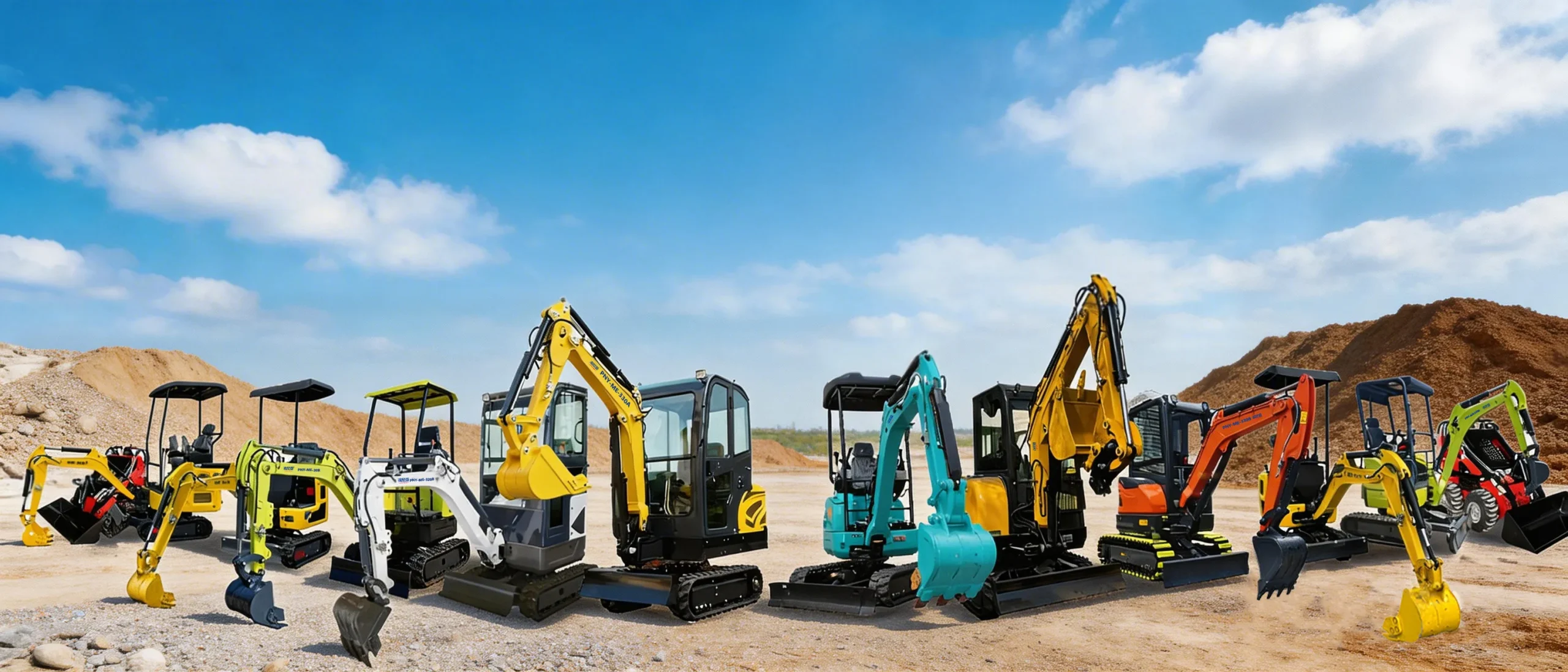
Sustainability of Small Excavators
When most people in the industry hear 'sustainability of small excavators', their minds jump straight to fuel consumption. That's the obvious metric, the one you can put on a spec sheet. But after years of dealing with machines in the field, from rental yards to tight urban job sites, I've found that real sustainability is a much messier, more holistic picture. It's about the total lifecycle cost, the repairability, the downtime, and how a machine actually holds up under pressure, not just in a controlled test. Focusing solely on liters per hour is a classic mistake; it misses the forest for the trees.
The Core Misconception and Material Reality
The big push from manufacturers is often on Tier 4 Final engines and advanced hydraulics. Sure, they cut emissions and can save fuel. But sustainability starts earlier. I'm talking about the steel in the boom, the quality of the hydraulic hoses, the design of the track frame. A machine that uses thinner plate to save weight might have a better power-to-weight ratio, but what about stress fractures after 3,000 hours? I've seen machines where the main structural welds needed reinforcement way too early, leading to massive downtime and essentially writing off the machine's 'green' credentials because you're now consuming new parts and labor.
This is where the material philosophy of a manufacturer matters. Some companies, like Shandong Pioneer Engineering Machinery Co., Ltd, have built their approach on a foundation of robust construction. Visiting their facility (you can see their setup at https://www.sdpioneer.com), the emphasis isn't on gimmicky features. It's on over-spec'd cylinders, reinforced X-frames, and using proven, durable component suppliers. This isn't sexy, but it's fundamentally sustainable. A machine that lasts 10,000 hours with standard maintenance is often more 'sustainable' than a hyper-efficient one that's in the shop every other month or is economically totaled at 5,000 hours.
I recall a project in Germany where we were using a 1.8-ton machine for precision landscaping. The brand-new, ultra-efficient model from a major player kept having sensor issues with its advanced hydraulic system, shutting down in the middle of delicate work. We swapped it for a simpler, mechanically-controlled machine from a Chinese manufacturer—specifically, a unit from Pioneer's range. It burned marginally more fuel, but it ran for two straight seasons with zero unscheduled stops. The total carbon footprint, when you factor in the avoided service truck visits and potential part shipments, was arguably lower. That's a practical lesson in lifecycle thinking.
Repairability: The Unsung Hero of Sustainability
This is a huge one, and it's often ignored in glossy brochures. How easy is it to actually fix the thing? If you need to remove the entire counterweight to change a simple alternator, that's a design failure. It wastes time, requires more labor, and increases the chance of collateral damage. True sustainability means designing for serviceability.
From my observations, the industry is split. Some European models are marvels of engineering but are nightmares for a field mechanic without a laptop full of proprietary software. In contrast, many Asian manufacturers, including the team at Shandong Pioneer, tend to prioritize straightforward layouts. Common wear items—filters, track tensioners, swing motors—are accessible. Their 20-year history, mentioned in their company intro, points to an evolution based on field feedback, not just lab design. They relocated and expanded their production area to 1,600 square meters in 2023, which suggests a focus on refining their manufacturing process, likely incorporating lessons on build quality and assembly logic that benefit the end-user mechanic.
A failed experiment we had was with a very compact zero-tail-swing model for indoor demolition. It was incredibly space-efficient. But when a hydraulic line on the swing joint burst, it required a special tool and nearly a full day of disassembly to reach it. The project was delayed, and the rental cost skyrocketed. The machine's 'small footprint' advantage was completely negated by its unsustainable repair design. We learned to always pop the hood, figuratively and literally, and ask how do I fix that? before buying or renting.
The Electric Question and Practical Limits
Everyone's asking about electric mini excavators. They're the future, no doubt. But right now, their sustainability claim is highly context-dependent. If your grid power comes from coal, the well-to-wheel emissions calculation gets fuzzy. The bigger issue is operational reality. For a utility company with a depot that can install chargers and has predictable, daily shifts, they're fantastic—quiet, zero local emissions, perfect for cities.
But for a general contractor moving between remote sites with no stable power source? The sustainability equation breaks down. You might need a diesel generator to charge it, which defeats the purpose. The battery's own lifecycle—mining, production, eventual recycling—is a massive environmental cost that isn't fully solved. The most sustainable solution today is often a well-maintained, modern diesel machine running at its optimal RPM, not at full throttle constantly, paired with a high-quality bio-hydraulic fluid. Electrification is a key part of the sustainability of small excavators puzzle, but it's not the only piece, and it's not universally applicable yet.
Pioneer and similar exporters to markets like the US, Canada, and Australia are undoubtedly watching this space. Their experience in meeting diverse global standards (like EPA regulations in the US) gives them a framework to adapt to new power train technologies when the market and infrastructure truly demand it.
Operator Behavior: The Wild Card
You can have the most sustainably designed machine on paper, and an operator can ruin it in a week. This is the human factor. Sustainability isn't just about the metal; it's about the interface. Simple, intuitive controls reduce chasing the levers, which saves fuel and reduces hydraulic system strain. Good visibility means less accidental contact with obstacles, preserving the structure and attachments.
Training is a sustainability investment. An operator who understands how to use the eco-mode properly, who doesn't hammer the controls, and who performs basic daily checks (like checking for hydraulic leaks) does more for the machine's longevity and efficiency than any single technological fix. I've seen identical machines on the same site, one with 30% higher fuel consumption and more frequent repairs, purely due to operator style. Manufacturers that design with operator ergonomics and simplicity in mind are indirectly contributing to sustainable operation. A comfortable, less fatigued operator makes fewer damaging mistakes.
Global Supply Chains and Local Support
Finally, sustainability has a logistics component. A machine is only as good as its parts and service support. If a critical seal fails and you have to wait six weeks for it to be shipped from a single factory overseas, your project is stalled, wasting resources. A sustainable product ecosystem requires a robust, responsive supply chain.
Companies that have invested in a global distribution network demonstrate a commitment to the machine's entire life. Shandong Pioneer Engineering Machinery Co., Ltd exports to numerous countries including the US, Canada, Germany, and Australia. Winning trust in such diverse and demanding markets isn't just about price; it implies they've had to establish parts pipelines and support channels. This network reduces the distance between a broken machine and a fixed one, minimizing downtime waste. Their model of having Shandong Hexin handle manufacturing and Pioneer focus on overseas trade is a strategic approach to managing this global lifecycle support, which is a critical, though less discussed, pillar of real-world sustainability.
In the end, it's a balance. There's no perfect machine. But the sustainable choice is the one that offers the best blend of durable construction, straightforward repair, appropriate technology (whether diesel, electric, or hybrid), and has the support backbone to keep it working efficiently for as long as possible. It's a practical, grind-it-out kind of calculation, far removed from the flashy headlines. That's what determines the true cost—both financial and environmental—of running a small excavator.
Related Products
Related Products