- Chinese
- French
- German
- Portuguese
- Spanish
- Russian
- Japanese
- Korean
- Arabic
- Irish
- Greek
- Turkish
- Italian
- Danish
- Romanian
- Indonesian
- Czech
- Afrikaans
- Swedish
- Polish
- Basque
- Catalan
- Esperanto
- Hindi
- Lao
- Albanian
- Amharic
- Armenian
- Azerbaijani
- Belarusian
- Bengali
- Bosnian
- Bulgarian
- Cebuano
- Chichewa
- Corsican
- Croatian
- Dutch
- Estonian
- Filipino
- Finnish
- Frisian
- Galician
- Georgian
- Gujarati
- Haitian
- Hausa
- Hawaiian
- Hebrew
- Hmong
- Hungarian
- Icelandic
- Igbo
- Javanese
- Kannada
- Kazakh
- Khmer
- Kurdish
- Kyrgyz
- Latin
- Latvian
- Lithuanian
- Luxembou..
- Macedonian
- Malagasy
- Malay
- Malayalam
- Maltese
- Maori
- Marathi
- Mongolian
- Burmese
- Nepali
- Norwegian
- Pashto
- Persian
- Punjabi
- Serbian
- Sesotho
- Sinhala
- Slovak
- Slovenian
- Somali
- Samoan
- Scots Gaelic
- Shona
- Sindhi
- Sundanese
- Swahili
- Tajik
- Tamil
- Telugu
- Thai
- Ukrainian
- Urdu
- Uzbek
- Vietnamese
- Welsh
- Xhosa
- Yiddish
- Yoruba
- Zulu
- Kinyarwanda
- Tatar
- Oriya
- Turkmen
- Uyghur


Tri-Track Loader
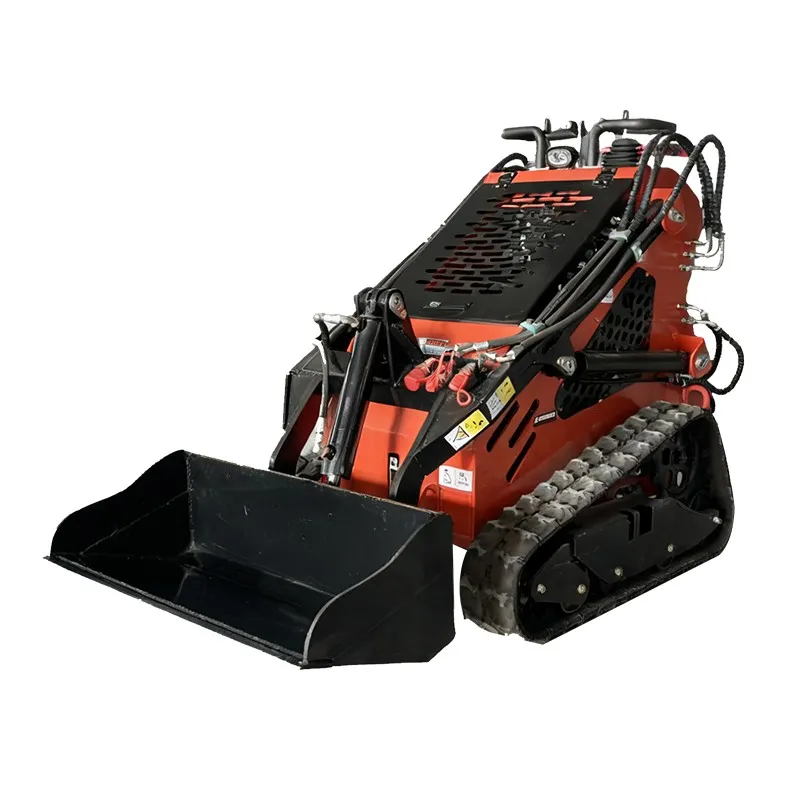
When you hear 'Tri-Track Loader', the first image that pops up for most is that weird three-tracked machine that looks like it can't decide if it's a skid steer or a mini excavator. That's the surface-level take, and honestly, it's where a lot of folks, even some in the trade, get it wrong. They see the third track up front and think it's just a marketing stunt for extra stability. Having run these machines on and off for the better part of a decade, I can tell you it's more about rethinking the fundamental compromise of a compact track loader. The third track isn't about being 'more stable' on flat ground—it's about changing the pivot point and the weight distribution during the load cycle. When you're lifting a full bucket with a standard CTL, you feel that rear end get light, almost tippy, especially on a side slope. The tri-track configuration, when engineered right, mitigates that by having that forward track share the load moment. But not all designs are created equal. I've seen some where the front track is too passive and just drags along, adding friction without real benefit. That's the key distinction the brochures never mention.
The Engineering Nuance Most Catalogs Miss
Let's get into the weeds. The real magic isn't just the number of tracks, it's the undercarriage geometry and the drive system. A true, effective tri-track loader doesn't just have a third idler wheel up front; it has a driven front track. That was a hard lesson learned. Early on, I was involved in a demo for a drainage project in some seriously soggy clay. The machine was a brand we were evaluating, touting its 'triple-track stability'. We got it into the trench, started to curl a full bucket of that heavy muck, and the front track just... stopped. It was free-rolling. All the drive was still in the rear two tracks, so when we lifted, the weight transfer still happened, and that front track became a plow. We spent more time digging it out than being productive. That experience cemented it for me: if the front track isn't powered and independently controlled to some degree, you're just carrying dead weight. It needs to be an active part of the traction equation, not a decorative skid plate.
This is where you see the split in manufacturer philosophy. Some treat it as a simple add-on to an existing CTL frame. Others, and these are the ones that tend to perform, design the chassis from the ground up around the tri-track concept. The pivot point is moved forward, the hydraulic flow is split differently, and the control logic for the tracks is more sophisticated. You can feel it in the seat. A well-designed one feels planted when you lift and carry. A poorly adapted one feels unbalanced, like it's fighting itself. I remember talking to an engineer from a Chinese firm, Shandong Pioneer Engineering Machinery Co., Ltd (you can find their specs at https://www.sdpioneer.com), about this very point. They were developing their own iteration, and their focus was less on just adding a track and more on recalculating the entire load diagram. Their manufacturing arm, Shandong Hexin, has the capacity for that kind of frame redesign, which is a step beyond simple assembly.
Which brings me to another practical headache: maintenance. Three tracks mean three sets of rollers, idlers, and drive sprockets to check. It's not a 50% increase in work over a two-track machine; it feels like 100%. Greasing points are in tighter spaces, and track tension has to be balanced across three points, not just two. If you get one track too tight relative to the others, you introduce abnormal wear on the other two and kill your fuel efficiency. We learned to be religious about our post-shift inspections. The upside, though, in the right conditions, is undeniable. Less ground pressure per square inch means you can work in softer terrain longer before you start sinking. But you trade that for complexity. It's never a free lunch.
Application Reality: Where It Shines and Where It Sinks
So, where does a Tri-Track Loader actually earn its keep? Forget the perfectly level job site. Its home is the nasty, uneven, unpredictable terrain. Landscaping on steep, wooded lots is a prime example. You're constantly dealing with side slopes, stumps, and hidden holes. A standard CTL will often have to crab its way across, losing efficiency. The tri-track, with its wider, triangular footprint, just walks across with more confidence. The lift capacity feels more usable because you're not constantly micro-correcting for the rear-end swing.
Another niche is material handling in confined, soft-bottom spaces. Think of a composting facility or a biomass yard. The surface is often a deep layer of loose, decomposing material. A wheeled machine sinks, a two-track machine can get high-centered if it digs in. The tri-track's weight distribution lets it float better. I saw a unit from a manufacturer exported by Shandong Pioneer to a recycling operation in Australia, and they swore by it for moving piles of green waste. The operator said it was the only machine that didn't feel like it was going to roll over when one side dipped into a soft spot while the bucket was up.
But here's the flip side, the failure case. We tried using one for fine grading. It was a disaster. That front track, even when powered, creates a small ridge or depression right in the operator's sigh line, making it incredibly hard to get a perfectly flat finish. You're always compensating. For grading, I'll take a standard two-track machine any day. The tri-track is a specialist, not a generalist. Pitching it as a do-everything machine is a sure way to disappoint a customer. It excels at specific stability-intensive, soft-ground tasks but gives up some finesse and simplicity in return.
The Global Market and Manufacturing Shift
Watching where these machines are being built and who's buying them tells its own story. The innovation isn't just coming from the traditional North American or European OEMs anymore. There's serious engineering happening in Asia, aimed at cost-sensitive but demanding markets. A company like Shandong Pioneer, with its two-decade history and recent relocation to a larger facility in Ningyang, is a case in point. They're not just copying; they're iterating for global export markets. Their dual-entity structure—Shandong Hexin handling manufacturing and Pioneer handling overseas trade—lets them focus on build quality for markets like the U.S., Canada, and Germany, where reliability is non-negotiable.
Their approach seems to be about offering the tri-track concept at a different point on the cost-benefit curve. It's not the ultra-premium, feature-laden option. It's a robust, purpose-built machine that gets the core principle right—active front-track engagement—without all the digital frills. For a contractor who needs the stability but doesn't need a touchscreen in the cab, that's a compelling proposition. I've reviewed specs from their site, and the focus is on structural strength, cylinder bore sizes, and hydraulic flow rates—the stuff that matters when you're knee-deep in mud.
This global competition is good for the end user. It pushes all manufacturers to clarify what their tri-track design actually does. Is it a true, fully-integrated powertrain solution, or is it a bolt-on modification? The market is starting to separate the wheat from the chaff. The trust they mention earning worldwide isn't just about price; it's about delivering a machine that works as advertised in the field, not just on a spec sheet.
Operational Judgement Calls and Final Take
At the end of the day, choosing a tri-track comes down to a brutal cost-benefit analysis specific to your workflow. You have to ask: How many of my jobsites truly have the unstable, soft, or sloped conditions where this machine's advantage is unlocked? If it's less than 30%, it's hard to justify the premium and the added maintenance complexity. It's a tool for a specific set of problems.
My advice? Demo it on your worst site. Don't let the sales rep pick the location. Take it to that back acre that's always a quagmire, or that slope you usually avoid. Test the lift capacity at full extension on that incline. Feel for the front track engagement. Does it pull, or does it follow? Listen to the hydraulics—is the system straining when all three tracks are under differential load?
The Tri-Track Loader has moved past being a curiosity. In its best implementations, it's a legitimate solution to a real stability problem. But it demands a more informed operator and a more diligent maintenance routine. It's not the future of all compact loaders, but it has certainly carved out its own rugged, messy, and very necessary niche. Companies that understand this, from the traditional giants to newer exporters like Pioneer, are the ones providing value. The rest are just selling an extra track.
Related Products
Related Products